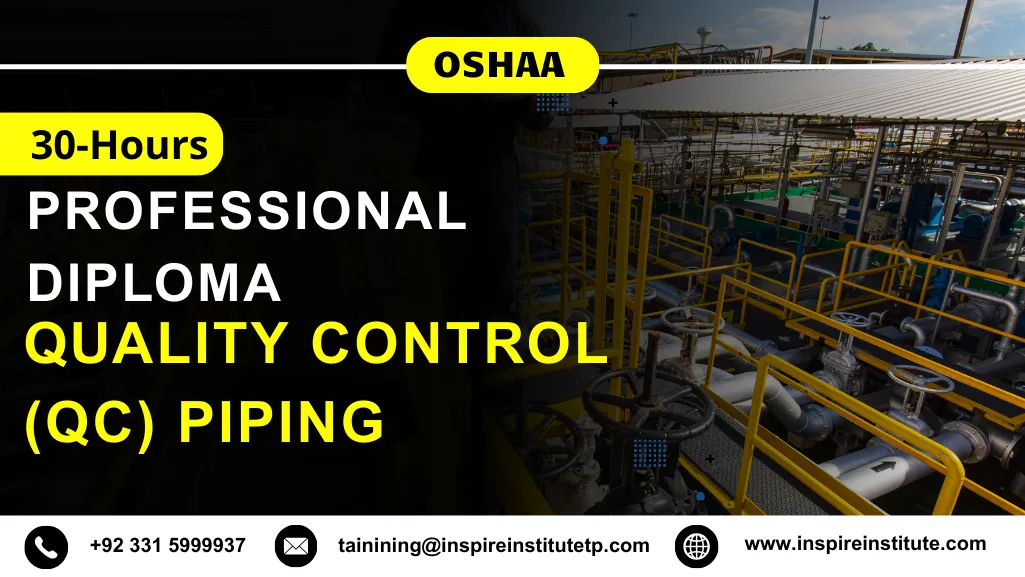
OSHAA 30-Hours Professional Diploma in Quality Control (QC) Piping

Overview

Certifying Body

OSHAA

Total Credits

30 HOURS

Evaluation

Assignments Based

Course Category

Quality Control

Learning Mood

Online

Qualification Structure

The study units below explain what learners will study and the learning outcomes they are expected to achieve.

  • Understand the fundamentals of quality control and its importance in piping systems
  • Identify key roles and responsibilities in a quality control framework
  • Recognise the impact of quality control on operational efficiency and safety
  • Gain awareness of typical challenges and solutions in QC processes
  • Identify common piping materials and their applications in industry
  • Understand the function of piping components such as valves, fittings, and flanges
  • Explain the basic principles of fabrication methods including cutting, bending, and welding
  • Recognise how material selection affects quality and system integrity
  • Understand the purpose and scope of key piping standards and codes
  • Identify relevant sections of ASME, API, and ISO standards for quality control
  • Apply standardised practices in evaluating piping system compliance
  • Interpret and integrate codes into inspection and documentation procedures
  • Understand various welding techniques used in piping fabrication
  • Interpret welding procedure specifications (WPS) and procedure qualification records (PQR)
  • Identify potential welding defects and their implications on system safety
  • Assess joint integrity using visual and standard testing methods
  • Read and interpret piping isometric drawings and process flow diagrams
  • Understand symbols, annotations, and line classifications used in piping schematics
  • Translate technical drawings into practical inspection checklists
  • Evaluate design requirements against installed systems
  • Understand the principles of NDT and its role in quality assurance
  • Identify common NDT techniques including ultrasonic, radiographic, magnetic particle, and dye penetrant testing
  • Determine appropriate NDT methods for specific inspection tasks
  • Interpret NDT results for defect detection and compliance reporting
  • Understand the purpose and structure of ITPs in quality management
  • Develop ITPs based on project scope, codes, and client specifications
  • Define hold points, witness points, and control stages within the inspection cycle
  • Coordinate with contractors, inspectors, and clients to implement ITPs effectively
  • Apply structured inspection methods across piping fabrication and installation stages
  • Identify common defects such as corrosion, cracks, misalignment, and weld discontinuities
  • Use inspection tools and gauges effectively in field applications
  • Develop practical approaches to defect classification and reporting
  • Understand the purpose and structure of key quality control documents
  • Accurately complete and verify inspection and testing records
  • Maintain compliance through correct documentation practices
  • Support audit readiness through systematic record keeping and data management
Entry Requirements

Entry Requirements

  • Applicants must be at least 18 years old at the time of enrollment.
  • A minimum of secondary education (high school or equivalent) is required. Preference is given to candidates holding a diploma or degree in engineering, mechanical, civil, or related technical fields, as these provide a strong foundation for QA/QC and OSHA training.
  • At least 1–2 years of relevant industry experience in construction, oil & gas, or mechanical fields
  • Ability to read, write, and communicate effectively in English
    Basic understanding of technical terminology used in QA/QC and OSHA standards

What You Need to Know

This course is ideal for engineers, supervisors, technicians, and fresh graduates who want to specialize in QA/QC piping inspection and OSHA safety compliance. It is also suitable for professionals in oil & gas, petrochemical, construction, and energy sectors seeking to upgrade their skills in quality control and safety standards.

You should take this course to gain a globally recognized OSHA 30-hour certification, enhance your technical expertise in piping QA/QC, and improve your career prospects. It provides practical training in inspection techniques, welding inspection, material testing, and OSHA compliance, preparing you for international projects.

  • Comprehensive training in QA/QC piping inspection aligned with OSHA safety standards
  • Hands-on experience with inspection tools, welding techniques, and material testing
  • Globally recognized certification accepted across multiple industries
  • Enhanced employability and career growth opportunities in high-demand technical sectors
  • Strong foundation for leadership roles in quality assurance and safety maagement

Graduates can pursue roles such as QC Piping Inspector, Welding Inspector, Safety Officer, Quality Control Engineer, and Pipeline Integrity Specialist. These positions are highly sought after in oil & gas, petrochemical, and construction industries worldwide.

This diploma opens pathways to senior QA/QC roles, advanced certifications like NDT (Non-Destructive Testing), and higher studies in engineering or safety management. It also prepares learners for leadership positions and consultancy roles in inspection and safety compliance.

Yes, the OSHA 30-Hours Professional Diploma in QC Piping is internationally recognized and accepted by employers across oil & gas, petrochemical, construction, and energy sectors. It aligns with global safety and quality standards, boosting your credibility and employability worldwide.

Apply for This Course


Similar Posts