Overview

Certifying Body

LICQual

Total Credits

60

Evaluation

Assignments Based

Qualification Type

Non Ofqual

Learning Mood

Online

Study Units

6

Qualification #

LICQ2201287

Qualification Structure

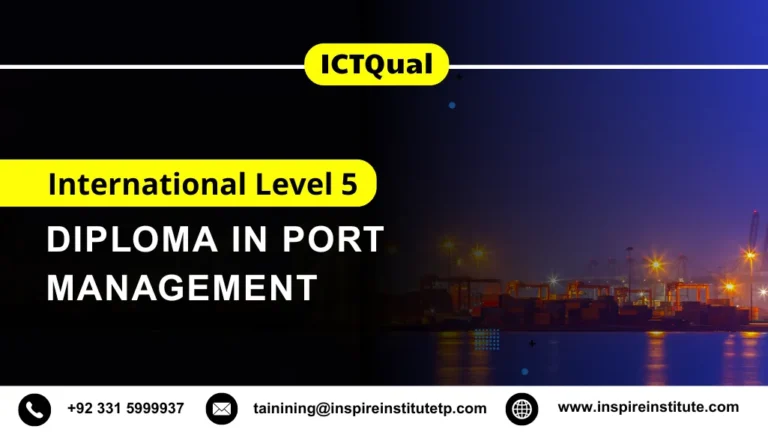
To achieve the LICQual UK Level 3 Diploma in Port Management;

Candidates must complete the following 6 Mandatory Units,

Mandatory Units

  • Introduction to Port and Harbour Management
  • Fundamentals of Port Operations and Cargo Handling
  • Shipping Documentation and Customs Procedures
  • Health, Safety, and Security in Port Environments
  • Warehousing, Storage, and Terminal Functions
  • Professional Skills for Port and Logistics Careers

Upon the Successfully Completion LICQual UK Level 3 Diploma in Port Management, learners will be able to

  •  Introduction to Port and Harbour Management

Learners will be able to:

  • Explain the role of ports and harbours in global trade and maritime logistics.
  • Identify key stakeholders in port management, including terminal operators and shipping lines.
  • Demonstrate understanding of different types of ports and their operational functions.
  • Analyze the importance of ports in supporting international supply chains.
  • Recognize career opportunities and pathways in port and harbour management.
  • Apply basic principles of port administration and governance.
  • Fundamentals of Port Operations and Cargo Handling

Learners will be able to:

  • Describe the processes involved in cargo handling, stowage, and terminal operations.
  • Apply knowledge of international standards for safe and efficient cargo handling.
  • Demonstrate understanding of containerization and multimodal transport systems.
  • Evaluate the importance of operational efficiency in port logistics.
  • Identify risks in cargo handling and propose safe handling solutions.
  • Recognize the role of technology in modern port operations.
  • Shipping Documentation and Customs Procedures

Learners will be able to:

  • Explain the purpose and use of key shipping documents such as bills of lading and airway bills.
  • Demonstrate understanding of customs clearance and international trade compliance.
  • Apply knowledge of Incoterms and their role in shipping contracts.
  • Evaluate the importance of accuracy and compliance in shipping documentation.
  • Recognize the impact of digitalization on customs and documentation processes.
  • Identify the role of documentation in reducing risks in international trade.
  • Health, Safety, and Security in Port Environments

Learners will be able to:

  • Demonstrate knowledge of international health and safety standards in ports.
  • Apply risk assessment techniques to ensure safe port operations.
  • Explain the importance of security protocols in preventing illegal activities.
  • Evaluate the role of ISPS Code and IMO regulations in port security.
  • Recognize the importance of emergency response planning in port environments.
  • Promote a culture of safety and compliance in port operations.
  • Warehousing, Storage, and Terminal Functions

Learners will be able to:

  • Explain the role of warehousing and storage in port logistics.
  • Demonstrate understanding of inventory management and cargo flow.
  • Apply knowledge of terminal functions including loading, unloading, and storage.
  • Evaluate the importance of efficiency in warehousing and terminal operations.
  • Recognize the role of automation and technology in modern warehousing.
  • Analyze the link between warehousing, ports, and global supply chains.
  • Professional Skills for Port and Logistics Careers

Learners will be able to:

  • Demonstrate effective communication and teamwork skills in port environments.
  • Apply problem‑solving and decision‑making skills to logistics challenges.
  • Recognize the importance of professional ethics and compliance in port operations.
  • Develop employability skills required for entry‑level roles in port and logistics management.
  • Apply continuous learning strategies to support career growth in maritime logistics.
  • Build confidence in applying theoretical knowledge to real‑world port operations.
Entry Requirements

Entry Requirements

  • Applicants must be at least 18 years old at the time of enrollment.
  • A minimum of secondary school education or equivalent is recommended.
  • No extensive experience is mandatory; however, basic exposure to port operations, shipping, or logistics is recommended
  • Since the course is delivered in English, learners must demonstrate competence in reading, writing, and communication skills.

What You Need to Know

This course is ideal for school leavers, administrative staff, and professionals seeking to start a career in port management, maritime operations, or logistics. It also suits individuals working in shipping, terminals, or freight operations who want to gain formal recognition and practical skills in port management.

You should take this course to gain a comprehensive understanding of port operations, cargo handling, terminal management, and maritime logistics. It equips learners with practical and administrative skills required to manage port activities efficiently while ensuring compliance with industry standards and safety regulations.

  • Knowledge of port operations, terminal management, and cargo handling
  • Practical skills for coordinating shipping and logistics activities
  • Understanding of maritime regulations, safety, and compliance standards
  • Improved employability and career readiness in port and maritime roles
  • Recognised Level 3 certification supporting career advancement

Graduates can pursue roles such as Port Operations Assistant, Terminal Coordinator, Shipping Administrator, Cargo Handling Officer, Logistics Support Officer, or Maritime Operations Assistant.

Learners can progress to higher-level diplomas in port management, maritime logistics, shipping operations, or supply chain management, moving towards supervisory or managerial positions.

Yes, the LICQual UK Level 3 Diploma in Port Management is internationally recognised and aligned with global vocational standards, providing valuable credentials for careers in port operations and maritime management worldwide.

Apply for This Course


Similar Posts