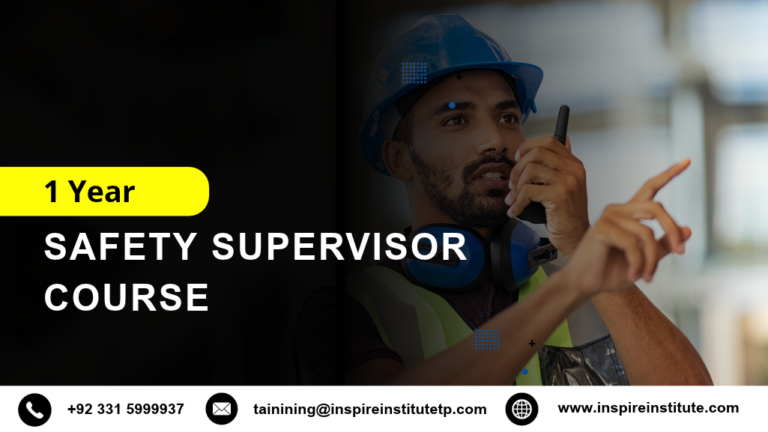
Health and Safety Management Course – 1 Year

The Health and Safety Management Course – 1 Year at Inspire Institute of Technologies Pakistan is a comprehensive vocational training programme designed to develop advanced knowledge and practical competencies in occupational health and safety management, workplace risk control and organisational safety procedures. This one-year course in Pakistan helps learners understand how to establish, implement, monitor and improve workplace health and safety practices across construction, manufacturing, engineering, industrial and commercial environments. It provides a structured learning pathway for individuals interested in developing professional skills in workplace safety management.

The programme covers essential occupational health and safety (OHS) principles, applicable workplace safety legislation, hazard identification, risk assessment, accident prevention, personal protective equipment (PPE), emergency preparedness and safety management systems. Learners develop an understanding of how to recognise workplace hazards, evaluate associated risks, recommend appropriate control measures and support organisations in maintaining safe and healthy working conditions. The course also explores safety policies, standard operating procedures, workplace inspections, safety documentation, incident investigation, workplace auditing, occupational hygiene, fire prevention and emergency response. Relevant provincial legislation, including the Khyber Pakhtunkhwa Occupational Safety and Health Act, 2022, is introduced in the context of workplace safety requirements applicable in Khyber Pakhtunkhwa.

The Health and Safety Management Course – 1 Year in Pakistan also develops an understanding of safety leadership, employee communication, compliance monitoring and continuous improvement in occupational health and safety practices. Offered by Inspire Institute of Technologies Pakistan, a TTB-affiliated training centre, this programme is suitable for beginners, employees, team leaders, supervisors and individuals seeking to strengthen their knowledge of workplace health and safety management. Through structured learning and practical activities, learners can build competencies relevant to supporting organisational safety programmes and managing workplace risks across different industries.

Overview

Certifying Body

TTB

Course Duration

1 Year

Fee

60,000/- Pkr

Study Units

12

Learning Mode

Online / Blended

Qualification Structure

The one-year Health and Safety Management Course covers the following recommended study units:

Mandatory Units

  1. Fundamentals of Occupational Health and Safety Management
  2. Occupational Health and Safety Legislation and Compliance
  3. Workplace Safety Policies, Procedures and Organisational Responsibilities
  4. Hazard Identification and Risk Assessment (HIRA)
  5. Risk Control Measures and Accident Prevention
  6. Personal Protective Equipment (PPE) and Safe Working Practices
  7. Workplace Safety Inspections, Monitoring and Auditing
  8. Accident and Incident Reporting and Investigation
  9. Fire Safety, Emergency Preparedness and Response
  10. Occupational Health, Hygiene and Environmental Safety
  11. Safety Communication, Training and Documentation
  12. Safety Management Systems and Continuous Improvement

After successfully completing the Health and Safety Management Course, Learners will be able to:

  1. Explain the fundamental principles, objectives and importance of occupational health and safety management.
  2. Describe the responsibilities of employers, employees, supervisors and safety personnel in maintaining safe working environments.
  3. Explain the structure and essential components of organisational occupational health and safety programmes.
  4. Develop an understanding of workplace safety policies, procedures, rules and organisational responsibilities.
  5. Explain the importance of safety committees, employee participation and workplace safety training.
  6. Demonstrate an understanding of relevant Pakistani occupational health and safety legislation and the Khyber Pakhtunkhwa Occupational Safety and Health Act, 2022.
  7. Identify physical, chemical, biological, mechanical, ergonomic and environmental workplace hazards.
  8. Recognise common hazards associated with machinery, electrical systems, lifting operations and confined spaces.
  9. Conduct structured workplace hazard identification activities.
  10. Carry out basic and task-specific risk assessments to evaluate workplace hazards.
  11. Apply the Hierarchy of Controls when recommending suitable risk reduction measures.
  12. Prepare basic risk assessment documents and recommend appropriate preventive actions.
  13. Identify unsafe acts and unsafe conditions and propose corrective measures.
  14. Explain the purpose and importance of personal protective equipment in workplace risk prevention.
  15. Select appropriate PPE according to identified workplace hazards and operational requirements.
  16. Describe the correct inspection, fitting, use, maintenance and storage of PPE.
  17. Explain the importance of workplace housekeeping, safe equipment handling and operational procedures.
  18. Conduct workplace safety inspections using appropriate checklists and observation techniques.
  19. Identify workplace conditions that may cause injuries, occupational illnesses or damage to equipment.
  20. Explain the principles of workplace safety monitoring and performance evaluation.
  21. Describe the purpose and basic requirements of internal workplace safety audits.
  22. Communicate safety requirements through toolbox talks, briefings and employee awareness sessions.
  23. Prepare workplace safety inspection reports, risk assessment records and hazard observation documents.
  24. Explain procedures for reporting and recording workplace accidents, incidents and near misses.
  25. Participate in basic incident investigations and identify immediate and underlying causes.
  26. Recommend corrective and preventive actions to reduce the likelihood of similar incidents.
  27. Explain the importance of emergency preparedness, evacuation planning and workplace response procedures.
  28. Identify common fire hazards and recommend appropriate fire prevention measures.
  29. Explain the purpose of fire extinguishers, fire alarms and emergency response arrangements.
  30. Describe basic first aid arrangements and workplace emergency responsibilities.
  31. Identify occupational health hazards, including noise, dust, heat stress, chemical exposure and poor ergonomic conditions.
  32. Explain the importance of industrial hygiene and maintaining healthy workplace conditions.
  33. Understand basic chemical safety information and the purpose of Safety Data Sheets (SDS).
  34. Explain the importance of environmental protection, waste management and safe workplace practices.
  35. Maintain basic occupational health and safety documentation and organisational records.
  36. Explain the role of Standard Operating Procedures (SOPs) in maintaining workplace safety.
  37. Understand the basic structure and purpose of occupational health and safety management systems.
  38. Explain the principles of continuous improvement and their application to workplace safety performance.
  39. Support the implementation and monitoring of organisational health and safety programmes.
  40. Recommend improvements to workplace safety procedures based on inspection findings, risk assessments and incident records.

Inspire Institute of Technologies Pakistan– TTB Affiliated Centre | Registration No. DTE&MT/TTB/IITP/ISB/14580.

Entry Requirements

Entry Requirements

  • Matric or an equivalent level of education is preferred. Intermediate education can be an added advantage.
  • General awareness of workplace activities, construction, manufacturing, engineering or industrial operations is beneficial.
  • Basic understanding of English or Urdu is recommended for interpreting safety instructions, legislation and course materials.
  • Previous experience in occupational health and safety, construction, engineering or industrial environments is beneficial but not compulsory.

What You Need to Know

Learners can develop skills in hazard identification, risk assessment, safety inspections, incident investigation, workplace auditing, emergency preparedness and safety documentation. The programme also supports communication, leadership, decision-making and problem-solving skills relevant to health and safety management.

Course completers may explore opportunities in workplace safety support, safety supervision and health and safety management environments. Potential roles may include Safety Officer, Safety Supervisor, HSE Assistant or Junior Health and Safety Coordinator, depending on practical competence, professional experience, employer requirements and additional certifications.

The course is suitable for beginners, job seekers, employees, construction workers, industrial staff, team leaders, supervisors and individuals interested in workplace safety management. It is also relevant to professionals seeking to strengthen their knowledge of occupational health and safety practices.

Health and safety management skills are relevant to construction, manufacturing, engineering, oil and gas, warehousing, logistics and industrial operations. These sectors require competent personnel to support risk management, workplace inspections, accident prevention and the implementation of safety procedures.

Inspire Institute of Technologies Pakistan offers vocational training focused on practical competencies and industry-relevant knowledge. Its TTB affiliation and structured one-year programme provide learners with an opportunity to develop occupational health and safety management skills, understand workplace risk control and strengthen their knowledge of safety procedures in Pakistan.


Apply for This Course

Similar Posts