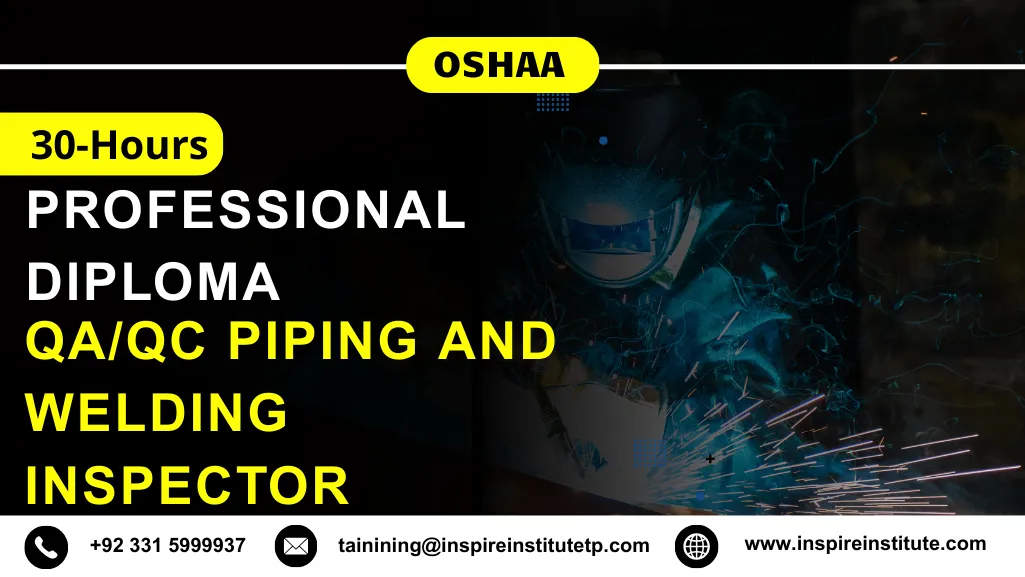
OSHAA 30-Hours Professional Diploma in QA/QC Piping and Welding Inspector

Overview

Certifying Body

OSHAA

Total Credits

30 HOURS

Evaluation

Assignments Based

Course Category

Quality Control

Learning Mood

Online

Qualification Structure

The study units below explain what learners will study and the learning outcomes they are expected to achieve.


  • Understand the fundamentals and significance of quality assurance and quality control in piping and welding
  • Identify the key responsibilities and roles of QA/QC professionals in engineering projects
  • Recognise the impact of effective QA/QC processes on safety, compliance, and project performance
  • Identify various types of piping materials and their properties
  • Understand the function and selection of piping components in different systems
  • Learn the standard fabrication processes used in industrial piping
  • Understand basic welding processes, equipment, and consumables
  • Learn the criteria and steps for procedure qualification (WPS, PQR)
  • Assess the relevance of welder performance qualification in quality control
  • Gain familiarity with major international standards applicable to piping and welding
  • Understand how these codes are applied in the inspection and QA/QC process
  • Interpret specific code requirements and their impact on documentation and practice
  • Identify and understand key NDT methods such as RT, UT, PT, MT, and VT
  • Learn when and how to apply each testing method in the field
  • Evaluate the strengths and limitations of NDT in defect detection
  • Develop the ability to perform accurate visual inspections of welded joints
  • Recognise common welding defects and understand their causes
  • Understand acceptance criteria as per relevant codes and standards
  • Learn to read and interpret piping isometric drawings and layout plans
  • Understand symbols, dimensions, and drawing conventions used in engineering documentation
  • Apply drawing interpretation skills to support inspection and quality tasks
  • Understand the structure and purpose of ITPs in project execution
  • Learn how to develop and implement effective quality control checklists and procedures
  • Identify hold points, witness points, and record-keeping practices in inspections
  • Understand the types of QA/QC documents used in piping and welding inspections
  • Learn how to prepare, review, and maintain critical quality records
  • Ensure documentation compliance with client specifications and regulatory standards
Entry Requirements

Entry Requirements

  • Applicants must be at least 18 years old at the time of enrollment.
  • A minimum of secondary school education (high school level or equivalent) is required. Candidates with a background in engineering, mechanical, or technical studies will have an added advantage.
  • Prior work experience in piping, welding, or industrial inspection is recommended but not mandatory.
  • Since the course is delivered in English, learners must demonstrate basic proficiency in reading, writing, and speaking English to understand technical standards, inspection procedures, and safety documentation.

What You Need to Know

The OSHAA 30-Hours QA/QC Piping and Welding Inspector Diploma is ideal for engineers, supervisors, technicians, and professionals working in oil & gas, construction, manufacturing, and power plant industries. It is also suitable for beginners who want to build a career in quality assurance and quality control.

This course provides specialized training in QA/QC inspection techniques, welding processes, material testing, and international codes and standards. By enrolling, you gain the skills to ensure compliance, improve safety, and enhance your career prospects in industrial projects worldwide.

  • Globally recognized QA/QC certification
  • Practical knowledge of piping and welding inspection
  • Expertise in non-destructive testing (NDT) and defect identification
  • Improved employability in high-demand industries
  • Strong foundation for career growth in quality management

Graduates can pursue roles such as QA/QC Inspector, Welding Inspector, Piping Inspector, Quality Engineer, or Project Supervisor. These positions are in demand across oil refineries, construction sites, fabrication workshops, and international industrial projects.

After completing the diploma, learners can progress to advanced certifications such as Certified Welding Inspector (CWI), Senior QA/QC Engineer, or Quality Manager. This qualification also serves as a pathway to leadership roles in project management and industrial safety.

Yes. The OSHAA 30-Hours QA/QC Piping and Welding Inspector Diploma is recognized across multiple countries, making it a valuable credential for professionals seeking international career opportunities in oil & gas, construction, and manufacturing industries.

Apply for This Course


Similar Posts