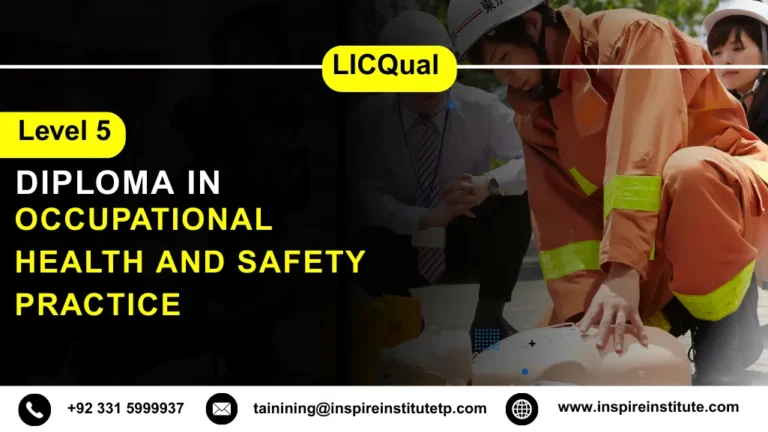
OAL Level 6 Diploma in Occupational Health and Safety Management

Overview

Certifying Body

OAL

TQT

510 Hours

Evaluation

Assessment Based

Study Units

8

Learning Mode

Online

Qualification Recognition & Progression

Expand Your Professional Opportunities

The OAL Level 6 Diploma in Occupational Health and Safety Management can support professional progression and may provide access to further recognition and verification pathways, subject to the requirements of the relevant organisations.

01
Professional Progression

BCSP – TSP® Pathway

The qualification provides a potential pathway towards the Transitional Safety Practitioner® (TSP®) designation through the Qualified Equivalent Program (QEP) of the Board of Certified Safety Professionals (BCSP).

Important: Eligibility is subject to formal QEP recognition and all applicable BCSP eligibility requirements.
02
Document Services

British Council

The qualification may also be suitable for document attestation, verification and related recognition processes through the British Council, subject to the applicable requirements and verification procedures.

Subject to: The requirements and procedures of the relevant authority.
03
International Documentation

Ministry of Foreign Affairs (MOFA)

The qualification may be suitable for document attestation, verification and related recognition processes through the Ministry of Foreign Affairs (MOFA), depending on the purpose and applicable requirements.

Important: Acceptance is subject to the relevant authority's verification criteria and procedures.

Professional & International Recognition

These pathways can support learners seeking professional progression, qualification verification or international documentation. Requirements may vary according to the organisation, country and intended purpose.

Qualification Structure

OAL Level 6 Diploma in Occupational Health and Safety Management training program consist of 8 mandatory units of 229 Guided Learning Hours (GLH) and 510 TQT (Total Qualification time).

Mandatory Units

  1. Develop the health and safety policy
  2. Prepare to implement the health and safety policy
  3. Manage work-based hazards through control measures
  4. Manage emergency response procedures
  5. Manage organisational health and safety competence and training
  6. Manage proactive health and safety monitoring in the workplace
  7. Manage reactive health and safety monitoring in the workplace
  8. Review health and safety management systems

Upon completing this Course students will be able to:

1. Develop the Health and Safety Policy

Learning Outcomes:

  • Analyse the legal and organisational requirements for a health and safety policy.
  • Develop a comprehensive health and safety policy aligned with organisational objectives.
  • Define roles, responsibilities, and arrangements within the policy.
  • Ensure stakeholder engagement and communication of the policy across the organisation.

2. Prepare to Implement the Health and Safety Policy

Learning Outcomes:

  • Plan the resources and actions required for effective policy implementation.
  • Identify and address barriers to implementation.
  • Develop an action plan with defined roles, responsibilities, and timeframes.
  • Establish communication strategies to support implementation.

3. Manage Work-Based Hazards Through Control Measures

Learning Outcomes:

  • Identify and evaluate common workplace hazards across various environments.
  • Apply appropriate risk assessment methodologies.
  • Recommend and implement suitable control measures in line with the hierarchy of control.
  • Monitor the effectiveness of implemented control measures and recommend improvements.

4. Manage Emergency Response Procedures

Learning Outcomes:

  • Assess organisational requirements for emergency preparedness.
  • Develop and document emergency response plans and procedures.
  • Coordinate emergency drills and simulations to test response capability.
  • Evaluate and revise emergency procedures based on outcomes and feedback.

5. Manage Organisational Health and Safety Competence and Training

Learning Outcomes:

  • Assess organisational training needs in relation to health and safety.
  • Develop a competence and training framework for all staff levels.
  • Implement effective training programmes and maintain accurate records.
  • Monitor training outcomes and update learning plans accordingly.

6. Manage Proactive Health and Safety Monitoring in the Workplace

Learning Outcomes:

  • Design and implement proactive monitoring systems and techniques.
  • Conduct routine inspections and audits to identify potential risks.
  • Analyse monitoring data to identify trends and areas for improvement.
  • Report findings and propose actions to enhance safety performance.

7. Manage Reactive Health and Safety Monitoring in the Workplace

Learning Outcomes:

  • Respond effectively to health and safety incidents and near misses.
  • Lead or support investigations into workplace incidents.
  • Identify root causes and contributing factors of incidents.
  • Implement corrective actions and update risk controls accordingly.

8. Review Health and Safety Management Systems

Learning Outcomes:

  • Evaluate the effectiveness of the current health and safety management system.
  • Identify areas for continuous improvement using data, audits, and stakeholder feedback.
  • Recommend and implement system improvements aligned with recognised standards (e.g., ISO 45001).
  • Develop reporting mechanisms to inform strategic decision-making.
Entry Requirements

Entry Requirements

  • Applicants must be at least 18 years old at the time of enrolment
  • Level 5 qualification or equivalent in Occupational Health and Safety or a related field.
  • Relevant workplace health and safety experience may be considered.
  • Suitable English language proficiency for study and assessment.

What You Need to Know

It can support progression into roles such as Health and Safety Manager, Safety Advisor, HSE Officer, Occupational Health and Safety Coordinator, and Risk Management Professional.

Construction, engineering, manufacturing, energy, logistics, facilities management, healthcare, and other workplaces require effective occupational health and safety management.

Key skills include risk analysis, hazard control, safety leadership, incident investigation, communication, compliance monitoring, and strategic decision-making.

Worker participation provides practical workplace knowledge, improves hazard identification, strengthens communication, and encourages shared responsibility for safety.

Choose this diploma to develop advanced occupational safety expertise, strengthen risk management skills, enhance career opportunities, and support effective workplace health and safety performance.

Apply for This Course

Similar Posts