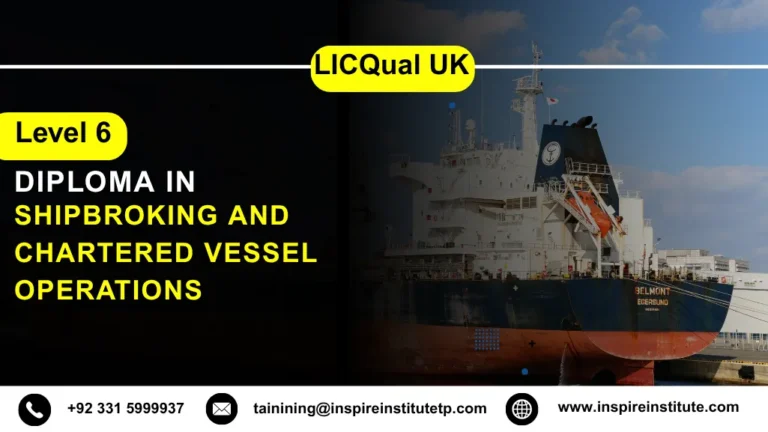
Overview

Certifying Body

LICQual

Total Credits

120

Evaluation

Assignments Based

Qualification Type

Non Ofqual

Learning Mood

Online

Study Units

6

Qualification #

LICQ2201286

Qualification Structure

To achieve the LICQual UK Level 6 Diploma in Shipping and Logistics;

Candidates must complete the following 6 Mandatory Units,

Mandatory Units

  • Strategic Maritime Shipping Management
  • Advanced Maritime Law and Risk Management
  • Global Supply Chain and Maritime Logistics
  • Port Economics and International Trade Policy
  • Sustainable Maritime Shipping and Environmental Management
  • Research Project in Maritime Shipping Operations

Upon the Successfully Completion LICQual UK Level 6 Diploma in Shipping and Logistics, learners will be able to

  • Strategic Shipping and Logistics Management

Learners will be able to:

  • Apply advanced management theories to global shipping and logistics organizations.
  • Evaluate strategic decision‑making processes in shipping operations and supply chains.
  • Analyze competitive advantages and market positioning in international logistics.
  • Develop leadership, communication, and problem‑solving skills for senior roles.
  • Formulate strategies for sustainable growth in shipping and logistics companies.
  • Assess the impact of globalization and digital transformation on logistics management.
  • Advanced Supply Chain Design and Global Logistics

Learners will be able to:

  • Design and evaluate advanced supply chain models for global logistics networks.
  • Apply optimization techniques to improve efficiency, cost, and delivery performance.
  • Assess the role of technology, automation, and digital platforms in supply chain visibility.
  • Demonstrate understanding of multimodal transport and integrated logistics systems.
  • Analyze risks and disruptions in global supply chains and propose mitigation strategies.
  • Evaluate the impact of international trade dynamics on supply chain design.
  • International Trade Law and Risk Management

Learners will be able to:

  • Interpret international trade laws, conventions, and compliance frameworks.
  • Evaluate the legal responsibilities of shipping companies, freight forwarders, and traders.
  • Apply knowledge of marine insurance, liabilities, and dispute resolution.
  • Analyze risk management strategies in shipping operations and global trade.
  • Assess the role of regulatory bodies in enforcing maritime safety and compliance.
  • Demonstrate critical understanding of case studies in trade law and arbitration.
  • Port Economics, Policy, and Infrastructure Development

Learners will be able to:

  • Evaluate the economic role of ports in facilitating global trade and logistics.
  • Analyze port pricing, competition, and efficiency models.
  • Assess the influence of international trade policies on port operations and development.
  • Apply knowledge of port investment, infrastructure planning, and modernization.
  • Examine the relationship between port economics and regional economic growth.
  • Demonstrate understanding of global trade flows and their impact on port logistics.
  • Sustainable Shipping, Logistics, and Environmental Practices

Learners will be able to:

  • Evaluate the environmental impact of shipping and logistics operations.
  • Apply knowledge of IMO regulations, MARPOL, and green shipping practices.
  • Analyze strategies for reducing emissions, fuel consumption, and carbon footprint.
  • Assess the role of innovation and technology in sustainable logistics operations.
  • Demonstrate awareness of corporate social responsibility in shipping management.
  • Develop sustainability frameworks for long‑term compliance in global logistics.
  • Research Project in Shipping and Logistics Operations

Learners will be able to:

  • Design and conduct independent research on a shipping or logistics topic.
  • Apply advanced research methodologies and data analysis techniques.
  • Critically evaluate academic and industry sources to support findings.
  • Present evidence‑based solutions to real‑world shipping and logistics challenges.
  • Demonstrate project management, critical thinking, and problem‑solving skills.
  • Produce a professional research report aligned with international academic standards.
Entry Requirements

Entry Requirements

  • Applicants must be at least 21 years old at the time of enrollment.
  • A Level 5 diploma or equivalent in shipping, logistics, supply chain management, business, or a related field is recommended.
  • Learners should have relevant industry experience, ideally in supervisory or managerial roles within shipping, logistics, or supply chain operations.
  • Since the program is delivered in English, applicants must demonstrate strong reading, writing, and communication skills.

What You Need to Know

This course is designed for experienced professionals in shipping, logistics, and supply chain management who aim to advance into senior management, strategic, or consultancy roles. It is also suitable for ambitious learners seeking expertise in global logistics and maritime operations.

You should take this course to gain advanced knowledge of shipping and logistics operations, develop strategic and leadership skills, and enhance your ability to manage complex supply chains and maritime operations in a global context.

  • Comprehensive understanding of advanced shipping, logistics, and supply chain management
  • Development of strategic planning, decision-making, and leadership skills
  • Knowledge of international trade regulations, port operations, and freight management
  • Enhanced career prospects in senior operational and managerial roles

Graduates can pursue roles such as Shipping and Logistics Manager, Supply Chain Director, Freight Operations Manager, Port Operations Manager, Maritime Logistics Consultant, or Senior Shipping Coordinator.

Learners can progress to postgraduate studies in Maritime Management, International Logistics, Supply Chain Strategy, or pursue specialised certifications in advanced shipping, freight forwarding, and global supply chain leadership.

Yes, the LICQual UK Level 6 Diploma in Shipping and Logistics is internationally recognised and aligned with global vocational standards, offering valuable credentials for careers in shipping, logistics, and supply chain management worldwide.

Apply for This Course


Similar Posts