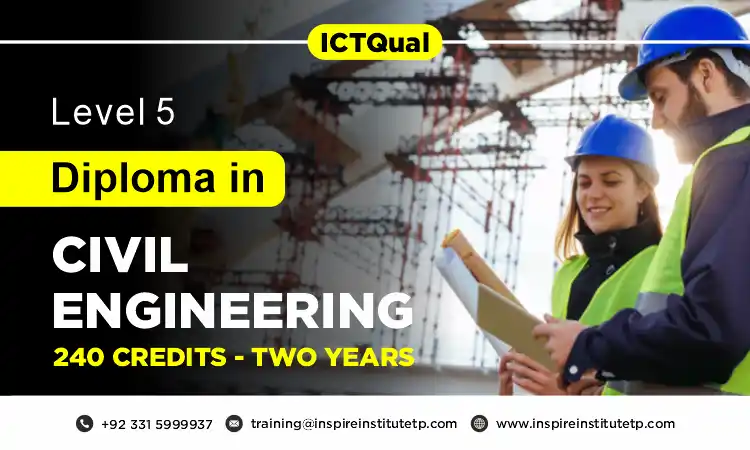
This extended diploma covers essential areas of civil engineering, including structural principles, construction technology, engineering mathematics, surveying, materials, project planning, and site management. Learners develop an understanding of engineering drawings, construction methods, technical specifications, quality control, and the application of engineering principles to real-world construction projects. The curriculum emphasises technical accuracy, problem-solving, and professional engineering practices.

The ICTQual AB Level 5 Extended Diploma in Civil Engineering also strengthens analytical, organisational, and project coordination skills. Learners gain valuable insight into construction operations, resource management, workplace safety, sustainable construction, and the technical challenges associated with modern infrastructure projects. These competencies support effective decision-making and responsible professional practice.

Overview

Certifying Body

ICTQual AB

Course Duration

18 to 24 Months

Credits

240

Study Units

12

Learning Mode

Online / Blended

Qualification Structure

The ICTQual AB Level 5 Extended Diploma in Civil Engineering is a comprehensive qualification consisting of 12 mandatory study units, with each unit carrying 20 credits, leading to a total of 240 credits required for the successful achievement of the qualification.

Mandatory Units

  1. Principles of Civil Engineering and Construction Technology
  2. Engineering Mathematics and Applied Mechanics
  3. Construction Materials and Building Technology
  4. Structural Engineering Principles and Design
  5. Surveying and Geomatics for Civil Engineering
  6. Geotechnical Engineering and Foundation Technology
  7. Highway Engineering and Transportation Infrastructure
  8. Hydraulics, Hydrology and Water Resources Engineering
  9. Construction Project Planning and Management
  10. Construction Health, Safety and Risk Management
  11. Sustainable Construction and Environmental Management
  12. Quality Assurance, Inspection and Professional Practice in Civil Engineering

1. Principles of Civil Engineering and Construction Technology

Upon successful completion of this unit, Learners will be able to:

  • Explain the fundamental principles, concepts and scope of civil engineering and its major disciplines.
  • Identify different types of construction and infrastructure projects and their engineering requirements.
  • Describe the stages of construction projects, from initial planning and design to execution and completion.
  • Explain modern construction methods, technologies and engineering practices used in the built environment.
  • Interpret basic engineering drawings, construction plans and technical specifications.
  • Evaluate the roles, responsibilities and professional practices of civil engineering and construction professionals.

2. Engineering Mathematics and Applied Mechanics

Upon successful completion of this unit, Learners will be able to:

  • Apply mathematical principles and engineering calculations to solve civil engineering problems.
  • Calculate measurements, dimensions, areas, volumes and quantities relevant to construction activities.
  • Explain the principles of forces, moments, equilibrium and motion in engineering systems.
  • Analyse basic force systems and structural behaviour using principles of applied mechanics.
  • Explain the relationship between stress, strain, deformation and material properties.
  • Interpret mathematical data, equations, graphs and technical calculations used in civil engineering applications.

3. Construction Materials and Building Technology

Upon successful completion of this unit, Learners will be able to:

  • Identify the properties, characteristics and applications of commonly used construction materials.
  • Explain the composition, production and performance of concrete, steel, timber, masonry and other building materials.
  • Evaluate the suitability of construction materials for different engineering and building applications.
  • Describe material testing procedures used to assess strength, durability and quality.
  • Explain factors affecting material performance, deterioration and service life.
  • Evaluate modern building technologies and sustainable materials used in construction projects.

4. Structural Engineering Principles and Design

Upon successful completion of this unit, Learners will be able to:

  • Explain the fundamental principles of structural engineering and their applications in civil engineering projects.
  • Identify different structural systems and components, including beams, columns, slabs and foundations.
  • Explain structural loads, including dead loads, imposed loads, wind loads and environmental loads.
  • Analyse basic structural behaviour in terms of equilibrium, stability, stress, strain and load distribution.
  • Interpret structural drawings, design information and technical specifications.
  • Evaluate factors affecting structural strength, safety, stability and serviceability.

5. Surveying and Geomatics for Civil Engineering

Upon successful completion of this unit, Learners will be able to:

  • Explain the principles, purposes and applications of land surveying in civil engineering projects.
  • Identify surveying instruments and describe their functions and appropriate applications.
  • Apply basic surveying techniques, including distance measurement, levelling, angle measurement and setting out.
  • Interpret survey data, field notes, maps and topographical drawings.
  • Explain the applications of GPS, GNSS, total stations and digital surveying technologies.
  • Evaluate the importance of surveying accuracy and precision in construction and infrastructure development.

6. Geotechnical Engineering and Foundation Technology

Upon successful completion of this unit, Learners will be able to:

  • Explain the fundamental principles of soil mechanics and geotechnical engineering.
  • Identify different soil types and evaluate their physical and engineering properties.
  • Describe site investigation procedures and common soil testing methods.
  • Explain soil strength, bearing capacity, permeability and settlement in relation to construction activities.
  • Identify different foundation types and evaluate their suitability for varying ground conditions.
  • Explain common causes of ground instability, foundation failure and the application of ground improvement techniques.

7. Highway Engineering and Transportation Infrastructure

Upon successful completion of this unit, Learners will be able to:

  • Explain the fundamental principles of highway engineering and transportation infrastructure development.
  • Describe highway alignment, geometric design and road layout requirements.
  • Identify construction materials and methods used in road and pavement development.
  • Differentiate between flexible and rigid pavement systems and explain their applications.
  • Explain the importance of traffic management, road drainage and transportation safety.
  • Evaluate pavement deterioration, maintenance requirements and sustainable highway construction practices.

8. Hydraulics, Hydrology and Water Resources Engineering

Upon successful completion of this unit, Learners will be able to:

  • Explain the fundamental principles of fluid mechanics and hydraulic engineering.
  • Describe fluid properties and apply basic principles of pressure, flow rate and fluid movement.
  • Explain the hydrological cycle and its importance in water resources management.
  • Identify the functions and applications of water supply, drainage and wastewater management systems.
  • Explain stormwater management, flood prevention and surface water drainage principles.
  • Evaluate sustainable water resource management practices and the applications of hydraulic structures.

9. Construction Project Planning and Management

Upon successful completion of this unit, Learners will be able to:

  • Explain the principles, processes and stages of construction project management.
  • Develop basic construction project plans, schedules, milestones and delivery programmes.
  • Apply resource allocation, labour planning and equipment management principles.
  • Explain construction cost estimation, budgeting, procurement and financial control processes.
  • Identify project risks and recommend appropriate risk management and mitigation strategies.
  • Evaluate project performance, stakeholder communication and coordination methods to support successful project delivery.

10. Construction Health, Safety and Risk Management

Upon successful completion of this unit, Learners will be able to:

  • Explain the principles of occupational health and safety within civil engineering and construction environments.
  • Identify common construction hazards and evaluate their potential risks to workers and other stakeholders.
  • Conduct basic workplace risk assessments and recommend appropriate control measures.
  • Explain safe working practices for excavation, working at height, lifting operations and construction equipment.
  • Describe emergency procedures, incident reporting and accident investigation processes.
  • Evaluate the importance of safety training, workplace supervision and continuous improvement in construction safety management.

11. Sustainable Construction and Environmental Management

Upon successful completion of this unit, Learners will be able to:

  • Explain the principles of sustainable development and their relevance to civil engineering projects.
  • Identify and evaluate environmental impacts associated with construction and infrastructure development.
  • Describe sustainable construction materials, energy-efficient technologies and resource conservation methods.
  • Explain waste reduction, recycling and reuse strategies within construction operations.
  • Evaluate environmental management practices for controlling pollution, noise, dust and water consumption.
  • Recommend sustainable construction solutions that minimise environmental impacts and support long-term infrastructure performance.

12. Quality Assurance, Inspection and Professional Practice in Civil Engineering

Upon successful completion of this unit, Learners will be able to:

  • Explain the principles of quality assurance, quality control and continuous improvement in civil engineering projects.
  • Identify relevant technical specifications, engineering standards and quality requirements for construction activities.
  • Describe construction inspection procedures, material testing methods and quality monitoring processes.
  • Identify common construction defects and recommend appropriate corrective and preventive actions.
  • Explain professional ethics, accountability, communication and responsibilities within the civil engineering profession.
  • Evaluate the importance of technical documentation, professional development and continuous learning in civil engineering practice.
Entry Requirements

Entry Requirements

  • Age Requirement: Applicants should normally be at least 18 years of age at the time of enrolment.
  • Educational Background: Learners should hold a Level 4 certification or an equivalent qualification in Civil Engineering, Construction, Engineering Technology, or another relevant technical discipline.
  • Professional Experience: Previous work experience in civil engineering, construction, site supervision, or infrastructure development is beneficial but not compulsory.
  • English Language Proficiency: Learners should have sufficient written and spoken English skills to understand technical materials, interpret engineering terminology, complete written assignments, and communicate effectively.
  • Relevant Industry Exposure: Familiarity with construction environments, engineering drawings, surveying, or building operations can provide an additional advantage.

What You Need to Know

Learners explore important areas of civil engineering, including construction technology, engineering principles, surveying, structural systems, construction materials, project planning, site management, and quality control. The study units develop technical knowledge relevant to modern construction and infrastructure projects.

This certification helps learners strengthen engineering knowledge, improve technical problem-solving abilities, understand construction operations, and develop professional competencies relevant to civil engineering and infrastructure development.

Yes. Working professionals in civil engineering, building construction, infrastructure development, and construction management can benefit from the programme by expanding their technical understanding and strengthening their professional capabilities.

Depending on previous experience, technical competencies, and employer requirements, learners may pursue opportunities in areas such as civil engineering support, construction supervision, site coordination, engineering consultancy, project assistance, and infrastructure development.

Learners can develop technical understanding, engineering problem-solving, analytical thinking, construction planning, surveying knowledge, technical communication, project coordination, and quality management skills.

Apply for This Course

Similar Posts