
What is Chemical Engineering? Complete Guide to Careers, Subjects, Skills and Opportunities in 2026
Chemical engineering is one of the most versatile and impactful engineering disciplines in the modern world. From producing life-saving medicines and clean drinking water to developing sustainable energy solutions and advanced materials, chemical engineers play a critical role in improving everyday life.
As industries continue to evolve through digital transformation, automation, and sustainability initiatives, the demand for skilled chemical engineering professionals remains strong across the globe. Whether you are a learner exploring career options, considering a diploma in chemical engineering, or simply curious about the profession, this guide will provide everything you need to know about chemical engineering in 2026.
What is Chemical Engineering?
Chemical engineering is a branch of engineering that applies principles of chemistry, physics, mathematics, biology, and engineering to design, develop, optimize, and operate industrial processes.
Chemical engineers transform raw materials into valuable products through efficient and safe manufacturing processes. These products include fuels, pharmaceuticals, food products, plastics, fertilizers, cosmetics, and countless other items used every day.
In simple terms, chemical engineering focuses on converting materials into useful products while ensuring efficiency, safety, quality, and sustainability.
Why is Chemical Engineering Important?
Chemical engineering is essential because it bridges the gap between scientific discoveries and industrial production.
Without chemical engineers, many products that modern society depends upon would not exist, including:
- Medicines and vaccines
- Fuels and energy products
- Food and beverages
- Water treatment systems
- Cleaning products
- Agricultural fertilizers
- Renewable energy technologies
Chemical engineers help industries improve productivity, reduce waste, enhance safety, and develop environmentally responsible solutions.
History and Evolution of Chemical Engineering
Chemical engineering emerged during the Industrial Revolution when industries required professionals who could combine scientific knowledge with manufacturing processes.
In the late nineteenth century, chemical engineering became recognized as a distinct engineering discipline. Initially focused on large-scale chemical production, the profession has expanded significantly over time.
Today, chemical engineers work in advanced fields such as:
- Biotechnology
- Nanotechnology
- Renewable energy
- Environmental engineering
- Artificial intelligence-driven manufacturing
- Sustainable process design
Modern chemical engineering continues to evolve as industries seek innovative solutions to global challenges.
What Does a Chemical Engineer Do?
Chemical engineers are responsible for designing, improving, and managing processes that convert raw materials into useful products.
Their work often includes:
Designing Production Processes
Chemical engineers develop systems and equipment used in industrial manufacturing facilities. These systems ensure products are produced efficiently and consistently.
Improving Operational Efficiency
They analyze production processes to identify inefficiencies, reduce waste, and improve productivity.
Ensuring Safety
Safety is a major priority in chemical engineering. Engineers design processes that minimize risks to workers, communities, and the environment.
Conducting Research and Development
Many chemical engineers work in research laboratories, developing new materials, products, and technologies.
Managing Industrial Projects
Chemical engineers often oversee production facilities, manage engineering teams, and coordinate large-scale industrial projects.
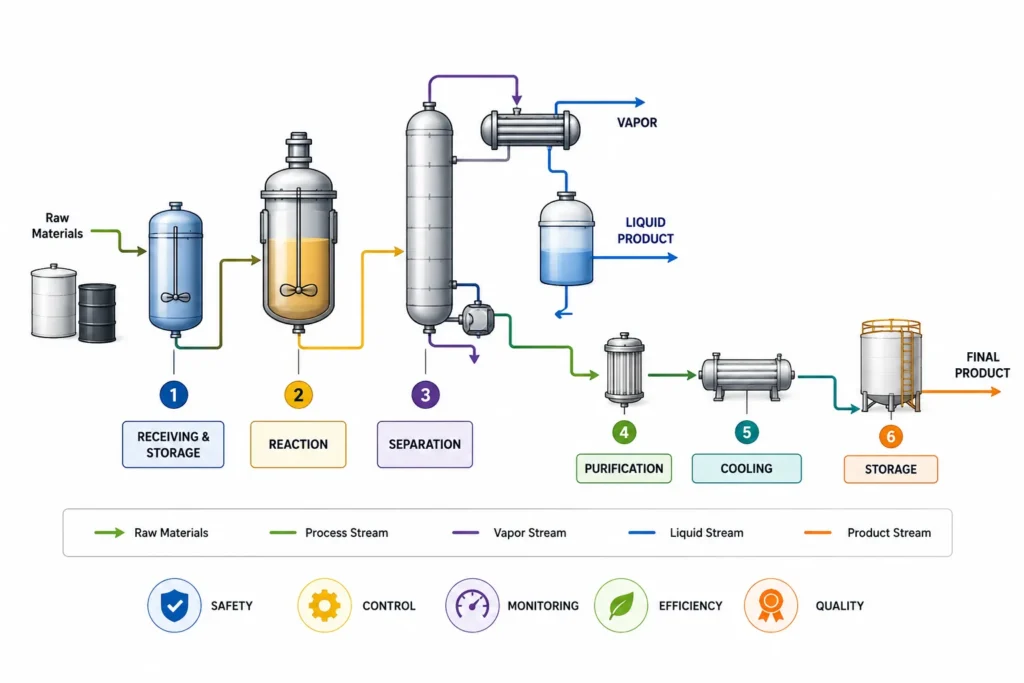
Core Principles of Chemical Engineering
Chemical engineering is built on several fundamental scientific and engineering principles that help professionals design, operate, and optimize industrial processes. These principles form the foundation of chemical engineering and are applied across industries such as manufacturing, energy, pharmaceuticals, food processing, and environmental management.
Thermodynamics
Thermodynamics is the study of energy, heat, and their interactions within physical and chemical systems. It helps chemical engineers understand how energy is generated, transferred, and utilized during industrial processes.
Key applications include:
- Optimizing energy consumption in manufacturing plants
- Designing efficient heating and cooling systems
- Improving fuel and power generation processes
- Understanding chemical reaction energy requirements
- Enhancing overall process efficiency and sustainability
Fluid Mechanics
Fluid mechanics focuses on the behavior and movement of liquids and gases under different conditions. Since many industrial processes involve the transportation of fluids, this principle is essential in chemical engineering.
Key applications include:
- Designing pipelines, pumps, and compressors
- Managing the flow of liquids and gases in production facilities
- Developing efficient water treatment systems
- Optimizing chemical processing equipment
- Improving transportation and distribution systems
Heat Transfer
Heat transfer studies how thermal energy moves between substances and systems through conduction, convection, and radiation. Efficient heat management is critical for maintaining product quality and process efficiency.
Key applications include:
- Designing heat exchangers and cooling systems
- Controlling temperatures during chemical reactions
- Improving energy efficiency in manufacturing plants
- Supporting power generation and refrigeration systems
- Enhancing safety and process reliability
Mass Transfer
Mass transfer involves the movement of substances from one location to another due to concentration differences. This principle is widely used in processes where materials need to be separated, purified, or mixed.
Key applications include:
- Water purification and treatment processes
- Gas absorption and filtration systems
- Distillation and separation operations
- Pharmaceutical manufacturing
- Food processing and product refinement
Chemical Reaction Engineering
Chemical reaction engineering focuses on understanding, designing, and controlling chemical reactions on an industrial scale. Chemical engineers use this knowledge to maximize production efficiency while maintaining product quality and safety.
Key applications include:
- Designing chemical reactors
- Optimizing reaction rates and production output
- Developing new products and materials
- Improving pharmaceutical and petrochemical manufacturing
- Reducing waste and production costs
Process Control
Process control involves monitoring and regulating industrial operations to ensure processes run safely, efficiently, and consistently. Modern facilities often use automated systems to maintain optimal operating conditions.
Key applications include:
- Monitoring temperature, pressure, and flow rates
- Maintaining product quality and consistency
- Improving operational efficiency
- Preventing equipment failures and safety incidents
- Supporting automation and smart manufacturing technologies
These core principles work together to help chemical engineers develop innovative solutions, improve industrial performance, and ensure safe and sustainable operations across a wide range of industries.
Key Chemical Engineering Subjects
Learners pursuing chemical engineering typically study a combination of scientific, technical, and engineering subjects.
Engineering Mathematics
Provides the analytical foundation required for solving complex engineering problems.
Engineering Chemistry
Develops an understanding of chemical reactions, materials, and industrial processes.
Physics for Engineers
Introduces fundamental concepts related to energy, mechanics, and material behavior.
Thermodynamics
Explores energy systems and process optimization.
Fluid Mechanics
Examines fluid flow and transportation systems.
Heat and Mass Transfer
Focuses on industrial processes involving energy and material movement.
Process Design
Teaches learners how to design and optimize industrial production systems.
Instrumentation and Control
Covers automation technologies used in modern manufacturing facilities.
Environmental Engineering
Addresses environmental protection and sustainable industrial practices.
Process Safety Management
Develops knowledge of workplace safety, hazard identification, and risk management.
Major Branches of Chemical Engineering
Chemical engineering encompasses a wide range of specialized fields.
Petrochemical Engineering
Focuses on refining crude oil and producing fuels, lubricants, and petrochemical products.
Pharmaceutical Engineering
Supports the development and manufacturing of medicines, vaccines, and healthcare products.
Food Process Engineering
Improves food production, preservation, packaging, and quality control processes.
Environmental Engineering
Develops solutions for pollution control, waste management, and environmental protection.
Biochemical Engineering
Applies biological processes to produce pharmaceuticals, biofuels, and biotechnology products.
Polymer Engineering
Specializes in plastics, synthetic materials, and advanced polymers.
Energy Engineering
Focuses on traditional and renewable energy production systems.
Nanotechnology Engineering
Develops innovative materials and technologies at the molecular level.
| Branch | Main Focus | Industries |
|---|---|---|
| Process Engineering | Production Processes | Manufacturing |
| Petrochemical Engineering | Oil & Gas Processing | Energy |
| Biochemical Engineering | Biological Processes | Pharmaceuticals |
| Environmental Engineering | Waste Management | Sustainability |
| Materials Engineering | Advanced Materials | Aerospace |
Industries That Employ Chemical Engineers
Chemical engineers are employed across numerous industries worldwide.
Oil and Gas Industry
Chemical engineers optimize refining processes, fuel production, and petrochemical manufacturing.
Pharmaceutical Industry
They help develop and manufacture safe and effective medicines.
Food and Beverage Industry
Chemical engineers improve production efficiency, food safety, and quality assurance.
Chemical Manufacturing
They design and manage processes used to produce industrial chemicals and consumer products.
Water Treatment Industry
Chemical engineers develop systems that provide safe drinking water and wastewater treatment.
Renewable Energy Sector
They contribute to solar energy, hydrogen production, biofuels, and sustainable energy solutions.
Environmental Protection
Chemical engineers help organizations reduce emissions and improve environmental performance.
Real-World Applications of Chemical Engineering
Chemical engineering affects almost every aspect of daily life.
Examples include:
- Producing clean drinking water
- Manufacturing medicines and vaccines
- Developing renewable energy technologies
- Processing food products
- Producing plastics and polymers
- Manufacturing fertilizers for agriculture
- Creating environmentally friendly materials
Without chemical engineering, many modern conveniences and technologies would not be possible.
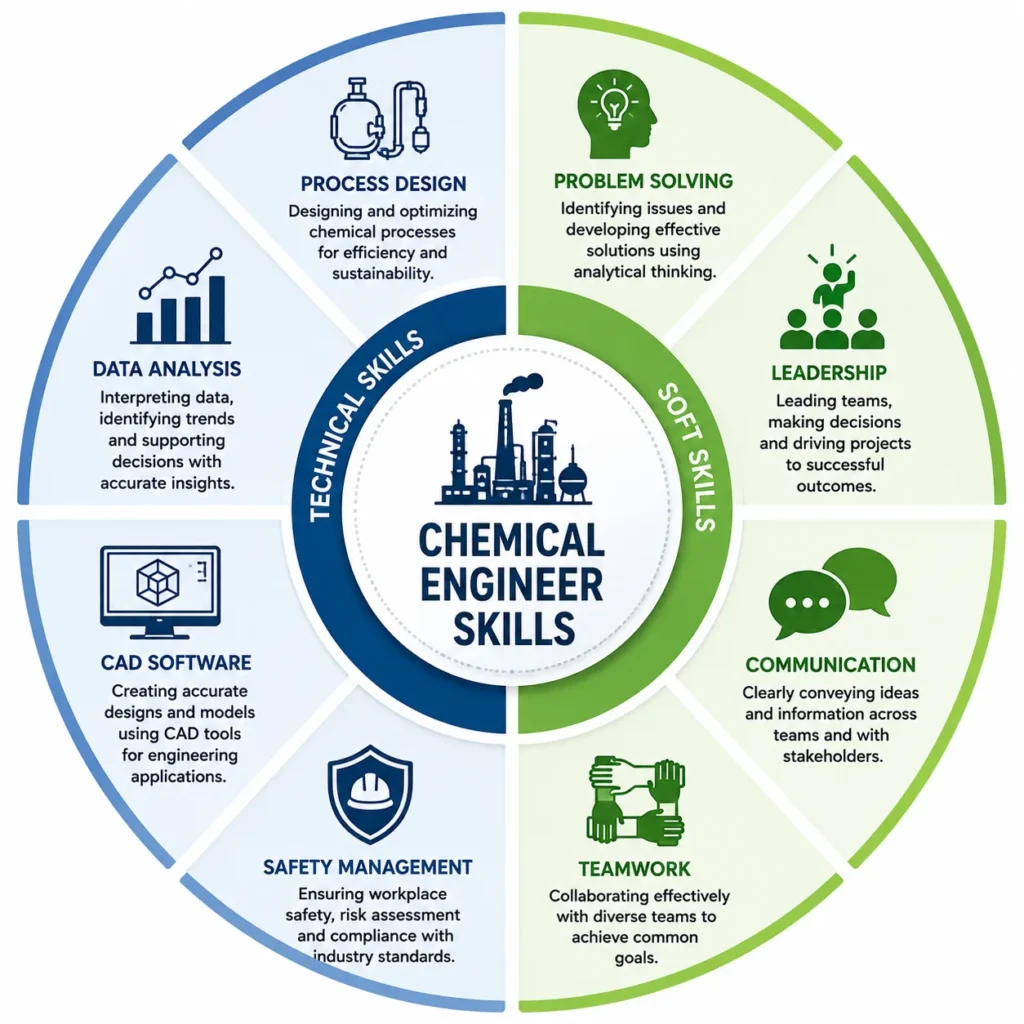
Skills Required to Become a Chemical Engineer
Successful chemical engineers possess a combination of technical and professional skills.
Analytical Thinking
Chemical engineers must analyze complex systems and identify effective solutions.
Problem-Solving Skills
They regularly solve technical challenges related to production, safety, and efficiency.
Mathematical Skills
Engineering calculations are essential for process design and optimization.
Communication Skills
Chemical engineers collaborate with teams, clients, and stakeholders.
Project Management
Many engineering roles require planning, coordination, and leadership abilities.
Safety Awareness
Understanding workplace safety and risk management is critical in industrial environments.
Digital Skills
Modern chemical engineers increasingly use software, automation systems, and data analytics tools.
How to Become a Chemical Engineer
There are several pathways into the chemical engineering profession.
Complete Relevant Education
Learners can begin with a diploma programme or pursue advanced engineering qualifications.
Gain Practical Experience
Industrial placements, internships, and practical projects help develop real-world skills.
Develop Technical Competencies
Building expertise in process design, safety management, and engineering software improves employability.
Obtain Professional Certifications
Industry-recognized certifications can enhance career prospects and demonstrate professional competence.
Continue Professional Development
Successful engineers continually update their knowledge to keep pace with technological advancements.
Benefits of Studying a Diploma in Chemical Engineering
A diploma in chemical engineering provides practical and industry-focused knowledge that prepares learners for technical roles within various industries.
Benefits include:
- Industry-relevant skills
- Practical learning opportunities
- Strong career prospects
- Flexible progression routes
- Enhanced employability
- Exposure to modern engineering technologies
Diploma programmes can provide an excellent pathway into engineering careers while developing the technical competencies required by employers.
Career Opportunities in Chemical Engineering
Chemical engineering graduates and diploma holders can pursue a wide range of career opportunities.
Process Engineer
Designs and optimizes industrial production processes.
Production Engineer
Manages manufacturing operations and production systems.
Plant Engineer
Oversees industrial facilities and equipment maintenance.
Quality Control Engineer
Ensures products meet quality standards and regulatory requirements.
Environmental Engineer
Develops solutions for pollution prevention and environmental sustainability.
Process Safety Engineer
Focuses on hazard management and workplace safety.
Research and Development Engineer
Develops innovative products and technologies.
Project Engineer
Coordinates engineering projects from planning through implementation.
Chemical Engineering Salary and Job Outlook
Chemical engineering continues to offer strong career prospects globally.
Factors influencing salary include:
- Education level
- Professional experience
- Industry sector
- Geographic location
- Technical specialization
Professionals with expertise in automation, sustainability, renewable energy, and advanced manufacturing are expected to remain highly sought after.
As industries continue investing in innovation and sustainability, employment opportunities for chemical engineers are projected to remain strong.
Chemical Engineering vs Other Engineering Disciplines
| Discipline | Focus Area |
|---|---|
| Chemical Engineering | Chemical Processes |
| Mechanical Engineering | Machines & Systems |
| Civil Engineering | Infrastructure |
| Electrical Engineering | Power & Electronics |
| Environmental Engineering | Sustainability |
Chemical Engineering vs Mechanical Engineering
Chemical engineering focuses on chemical processes and material transformations, while mechanical engineering primarily deals with machines, mechanics, and physical systems.
Chemical Engineering vs Civil Engineering
Civil engineering focuses on infrastructure projects such as roads and buildings, whereas chemical engineering focuses on industrial processes and manufacturing systems.
Chemical Engineering vs Electrical Engineering
Electrical engineering deals with electrical systems and electronics, while chemical engineering focuses on chemical reactions and process technologies.
Chemical Engineering vs Industrial Engineering
Industrial engineering emphasizes efficiency and workflow optimization, while chemical engineering focuses on chemical processes and production technologies.
Emerging Trends in Chemical Engineering
Technological innovation continues transforming the chemical engineering profession.
Artificial Intelligence
AI is increasingly used for process optimization, predictive maintenance, and production planning.
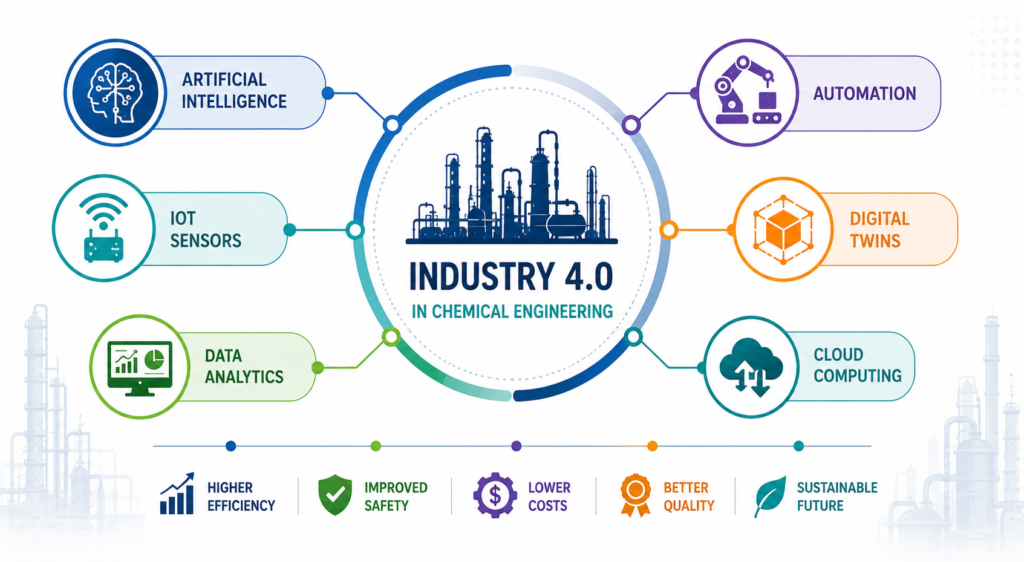
Industry 4.0
Smart manufacturing systems are improving efficiency and reducing operational costs.
Green Engineering
Organizations are adopting sustainable production methods to minimize environmental impact.
Renewable Energy
Chemical engineers are contributing to hydrogen technologies, biofuels, and clean energy systems.
Carbon Capture Technologies
Advanced carbon reduction solutions are becoming increasingly important in industrial operations.
Advanced Materials
Innovations in nanotechnology and materials science are creating new opportunities across industries.
Why Chemical Engineering is Important for Sustainability
Chemical engineers play a critical role in supporting sustainable development.
They help organizations:
- Reduce energy consumption
- Minimize waste generation
- Improve resource efficiency
- Develop environmentally friendly products
- Reduce greenhouse gas emissions
- Implement cleaner production technologies
As global sustainability goals become increasingly important, chemical engineers will continue driving innovation and environmental responsibility.
Future Scope of Chemical Engineering
The future of chemical engineering is highly promising.
Growing industries such as:
- Renewable energy
- Biotechnology
- Pharmaceuticals
- Sustainable manufacturing
- Water treatment
- Advanced materials
are creating significant demand for skilled professionals.
Chemical engineers will remain essential for solving some of the world’s most pressing challenges, including climate change, energy security, environmental protection, and sustainable industrial development.
Conclusion
Chemical engineering is one of the most dynamic and influential engineering disciplines in the modern world. By combining science, technology, and innovation, chemical engineers help create products, processes, and solutions that improve quality of life and support global development.
From healthcare and energy to manufacturing and environmental protection, chemical engineering continues to shape the future of industry and sustainability. For learners seeking a rewarding and future-focused career, studying chemical engineering can open the door to diverse opportunities, professional growth, and meaningful contributions to society.
Frequently Asked Questions (FAQs)
Have questions about Chemical Engineering? Explore the answers to some of the most commonly asked questions about chemical engineering careers, subjects, skills, qualifications, industries, and future opportunities.