
What Is the Difference Between Civil Engineering and Environmental Engineering?Which engineering field is better in 2026?
Civil Engineering and Environmental Engineering are closely related disciplines, but they have different primary objectives. Civil Engineering focuses on designing, constructing, and maintaining infrastructure such as roads, bridges, buildings, tunnels, dams, railways, and water supply systems. Its main goal is to create safe, durable, and efficient structures that support communities and economic development.
Environmental Engineering, on the other hand, concentrates on protecting human health and the environment. Environmental engineers develop solutions to challenges such as water and wastewater treatment, air pollution control, waste management, contaminated land remediation, renewable energy integration, and sustainable resource management. Their work helps reduce environmental impacts while ensuring compliance with environmental regulations.
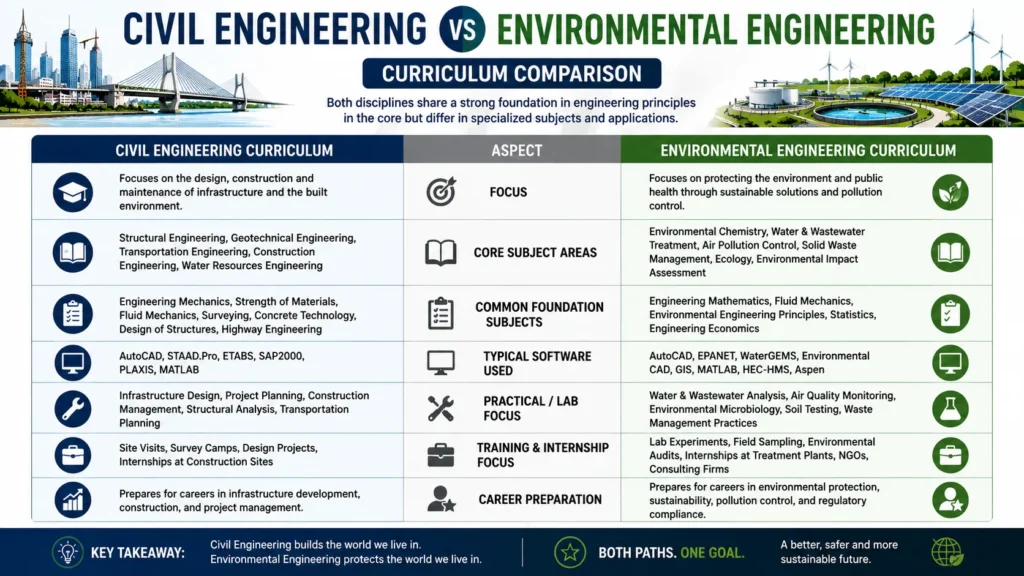
Civil Engineering vs Environmental Engineering Curriculum Comparison
The table below compares the typical curriculum found in accredited undergraduate engineering programs.
| Study Area | Civil Engineering Curriculum | Environmental Engineering Curriculum |
|---|---|---|
| Mathematics | Calculus, Differential Equations, Statistics | Calculus, Differential Equations, Statistics |
| Basic Sciences | Physics, Chemistry | Physics, Chemistry, Biology |
| Engineering Fundamentals | Engineering Mechanics, Engineering Drawing, Materials Science | Engineering Mechanics, Environmental Chemistry, Materials Science |
| Structural Engineering | Reinforced Concrete Design, Steel Structures, Structural Analysis | Basic Structural Engineering Concepts |
| Transportation Engineering | Highway Engineering, Traffic Engineering, Pavement Design | Limited or elective study |
| Geotechnical Engineering | Soil Mechanics, Foundation Engineering | Basic Soil Science and Contaminated Site Assessment |
| Water Resources | Hydrology, Hydraulic Engineering, Irrigation Systems | Water Supply Engineering, Hydrology, Water Resource Management |
| Environmental Systems | Introductory Environmental Engineering | Air Pollution Control, Wastewater Treatment, Solid Waste Management |
| Chemistry | General Chemistry | Advanced Environmental Chemistry |
| Biology | Minimal | Microbiology, Ecology, Environmental Biology |
| Sustainability | Sustainable Infrastructure | Sustainable Development, Climate Change Mitigation, Circular Economy |
| Waste Management | Basic Environmental Topics | Hazardous Waste, Municipal Waste, Recycling Systems |
| Air Quality | Limited Coverage | Air Pollution Monitoring and Control |
| GIS & Modeling | Surveying, GIS, Civil Design Software | GIS, Environmental Modeling, Water Quality Modeling |
| Laboratory Work | Construction Materials, Soil Testing, Structural Testing | Water Quality Testing, Air Monitoring, Microbiology Labs |
| Capstone Project | Infrastructure Design Project | Environmental Sustainability or Pollution Control Project |
What Are the Similarities Between Civil Engineering and Environmental Engineering?
Civil Engineering and Environmental Engineering are closely related disciplines that share the same engineering foundation and often work together on infrastructure and sustainability projects. Both fields apply scientific knowledge, mathematics, and engineering principles to solve real-world problems, improve public safety, and enhance the quality of life. While Civil Engineering primarily focuses on designing and constructing infrastructure and Environmental Engineering emphasizes protecting the environment, the two professions frequently collaborate to develop resilient, sustainable, and efficient communities.
Key Similarities Between Civil and Environmental Engineering
| Similarity | Explanation |
|---|---|
| Shared Engineering Foundation | Both disciplines are built on mathematics, physics, chemistry, and engineering principles to solve complex technical challenges. |
| Infrastructure Development | Both contribute to planning, designing, constructing, and maintaining infrastructure that supports modern society. |
| Water Resource Management | Engineers in both fields work on water supply systems, stormwater drainage, flood control, and hydraulic infrastructure. |
| Commitment to Public Safety | Protecting public health, safety, and welfare is a primary objective of both professions. |
| Sustainability Focus | Both promote sustainable development by designing infrastructure that minimizes environmental impacts and conserves resources. |
| Project Management | Civil and Environmental Engineers oversee project planning, budgeting, scheduling, quality control, and risk management. |
| Engineering Software | Both use tools such as AutoCAD, Civil 3D, GIS, BIM, hydraulic modeling software, and data analysis applications. |
| Regulatory Compliance | Both must follow engineering standards, environmental regulations, building codes, and safety requirements. |
| Team Collaboration | They regularly work alongside architects, urban planners, surveyors, contractors, scientists, and government agencies. |
| Diverse Career Opportunities | Both can build careers in government organizations, engineering consultancies, construction firms, utilities, research institutions, and multinational companies. |
Shared Subjects in Their Degree Programs
Civil Engineering and Environmental Engineering students typically study many of the same core subjects during the early years of their degree, including:
- Engineering Mathematics
- Calculus and Statistics
- Physics
- Chemistry
- Engineering Mechanics
- Fluid Mechanics
- Engineering Graphics and CAD
- Materials Science
- Surveying
- Hydraulics
- Engineering Economics
- Project Management
- Computer Programming for Engineers
These subjects provide the technical foundation before students specialize in structural, transportation, geotechnical, or environmental systems.
Common Skills Required
Professionals in both fields need a similar set of technical and professional skills, including:
- Analytical thinking
- Problem-solving abilities
- Strong mathematical skills
- Technical report writing
- Computer-aided design (CAD)
- Data analysis and interpretation
- Communication and teamwork
- Project management
- Critical thinking
- Knowledge of engineering standards and regulations
Projects Both Engineers Work On
Civil and Environmental Engineers frequently collaborate on projects such as:
- Water treatment plants
- Wastewater treatment facilities
- Stormwater drainage systems
- Flood mitigation projects
- Sustainable urban development
- Green infrastructure projects
- Highway and bridge developments
- Dam and reservoir construction
- Coastal protection systems
- Land development and site planning
- Smart city infrastructure
- Climate resilience initiatives
Although they contribute differently, both professionals work toward creating infrastructure that is safe, efficient, and sustainable.
How Their Roles Overlap
The responsibilities of Civil and Environmental Engineers often intersect during large infrastructure projects. For example:
- A Civil Engineer designs the structural components of a water treatment plant, while an Environmental Engineer designs the treatment processes that ensure safe drinking water.
- During highway construction, Civil Engineers design roads and bridges, whereas Environmental Engineers assess environmental impacts and recommend measures to protect ecosystems.
- In urban development projects, both engineers collaborate to integrate sustainable drainage systems, efficient water management, and environmentally responsible construction practices.
Which Engineering Discipline Has a Broader Scope?
Civil Engineering has a broader overall scope than Environmental Engineering. It encompasses the planning, design, construction, operation, and maintenance of infrastructure such as roads, bridges, buildings, airports, tunnels, dams, railways, ports, water supply systems, and transportation networks. Environmental Engineering is a specialized branch of engineering that focuses on protecting public health and the environment through solutions for water and wastewater treatment, air pollution control, waste management, environmental remediation, and sustainable resource management.
Because Civil Engineering covers multiple major specializations—including structural, transportation, geotechnical, construction, water resources, coastal, and municipal engineering—it offers a wider range of career paths and industries. Environmental Engineering has a narrower but highly specialized scope, concentrating on environmental protection, sustainability, climate resilience, pollution prevention, and regulatory compliance.
Why Civil Engineering Has a Broader Scope
Civil Engineering is one of the oldest and most diverse engineering disciplines. Civil Engineers work on nearly every aspect of the built environment, including:
- Buildings and skyscrapers
- Roads and highways
- Bridges and tunnels
- Airports and railways
- Dams and reservoirs
- Coastal and marine infrastructure
- Water supply systems
- Stormwater drainage
- Urban development
- Construction management
This wide range of projects allows Civil Engineers to specialize in numerous fields and work across public infrastructure, private construction, transportation, energy, and land development.
Why Environmental Engineering Is More Specialized
Environmental Engineering focuses on solving environmental challenges and ensuring sustainable development. Common areas include:
- Drinking water treatment
- Wastewater treatment
- Air pollution control
- Solid and hazardous waste management
- Soil and groundwater remediation
- Environmental Impact Assessment (EIA)
- Climate change adaptation
- Renewable energy integration
- Environmental compliance
- Sustainable resource management
Although its scope is narrower, Environmental Engineering is becoming increasingly important due to stricter environmental regulations, climate change, and growing sustainability goals.
What Soft Skills Are Important for Both Civil and Environmental Engineering Careers?
Technical knowledge is essential in both Civil Engineering and Environmental Engineering, but soft skills are equally important for long-term career success. Engineers regularly collaborate with multidisciplinary teams, communicate with clients and government agencies, manage complex projects, and solve real-world challenges. Strong interpersonal and leadership abilities help engineers deliver projects efficiently while meeting safety, quality, and environmental standards.
Below are the most valuable soft skills shared by professionals in both fields.
| Soft Skill | Why It Matters |
|---|---|
| Communication | Engineers must clearly explain technical concepts to clients, contractors, government officials, and team members through reports, presentations, and meetings. |
| Problem-Solving | Every engineering project involves challenges that require practical, innovative, and cost-effective solutions. |
| Critical Thinking | Engineers analyze technical data, evaluate risks, and make informed decisions throughout the project lifecycle. |
| Teamwork | Civil and Environmental Engineers work closely with architects, surveyors, planners, scientists, contractors, and other engineering professionals. |
| Leadership | Senior engineers often supervise teams, coordinate projects, mentor junior staff, and manage stakeholders. |
| Project Management | Managing schedules, budgets, resources, and project milestones is essential for successful project delivery. |
| Time Management | Engineers frequently balance multiple projects while meeting strict deadlines and regulatory requirements. |
| Adaptability | Projects evolve due to changing regulations, technologies, environmental conditions, and client needs, requiring engineers to adapt quickly. |
| Decision-Making | Engineers must make sound technical and operational decisions that prioritize safety, efficiency, and sustainability. |
| Attention to Detail | Accurate calculations, precise designs, and thorough documentation help prevent costly errors and ensure compliance. |
| Negotiation Skills | Engineers often coordinate with contractors, suppliers, regulators, and clients to resolve technical and contractual issues. |
| Ethical Judgment | Maintaining professional integrity and prioritizing public safety and environmental responsibility are fundamental engineering obligations. |
| Emotional Intelligence | Understanding team dynamics, managing conflicts, and building positive working relationships improve collaboration and project outcomes. |
| Creativity and Innovation | Developing efficient designs and sustainable engineering solutions often requires creative thinking and continuous improvement. |
| Resilience | Engineers must remain focused and productive when managing project delays, design revisions, budget constraints, and unexpected site challenges. |
Industries That Hire Both Civil and Environmental Engineers
Civil Engineers and Environmental Engineers work in many of the same industries because modern infrastructure projects must balance engineering performance, public safety, and environmental sustainability. While Civil Engineers typically focus on designing and constructing infrastructure, Environmental Engineers ensure projects comply with environmental regulations and minimize their impact on natural resources. This collaboration creates strong career opportunities across both the public and private sectors.
Industries That Employ Both Civil and Environmental Engineers
| Industry | Role of Civil Engineers | Role of Environmental Engineers |
|---|---|---|
| Construction | Design and oversee buildings, roads, bridges, and infrastructure. | Ensure construction activities comply with environmental regulations and sustainability standards. |
| Infrastructure Development | Plan and design transportation, utilities, and public infrastructure. | Assess environmental impacts and recommend sustainable engineering solutions. |
| Water and Wastewater Utilities | Design pipelines, reservoirs, pumping stations, and distribution networks. | Design water treatment and wastewater treatment processes and monitor water quality. |
| Government Agencies | Manage public infrastructure, transportation, and municipal projects. | Develop environmental policies, conduct compliance inspections, and oversee environmental protection programs. |
| Engineering Consulting | Provide structural, transportation, and construction consulting services. | Deliver environmental assessments, permitting, sustainability planning, and pollution control solutions. |
| Energy and Utilities | Design supporting infrastructure for power plants and energy facilities. | Manage emissions, waste, water resources, and environmental compliance. |
| Transportation | Develop highways, railways, airports, tunnels, and ports. | Conduct environmental impact studies and recommend mitigation measures. |
| Urban Planning and Development | Design residential, commercial, and mixed-use developments. | Integrate green infrastructure, stormwater management, and sustainable land use practices. |
| Mining and Natural Resources | Design access roads, foundations, and site infrastructure. | Manage environmental monitoring, land reclamation, waste disposal, and water protection. |
| Manufacturing | Design industrial facilities and site infrastructure. | Improve waste management, pollution control, and environmental compliance. |
| Renewable Energy | Design foundations and infrastructure for wind, solar, and hydroelectric projects. | Assess environmental impacts and develop sustainability strategies. |
| Disaster Recovery and Climate Resilience | Rebuild damaged infrastructure and improve structural resilience. | Restore ecosystems, manage contaminated sites, and reduce environmental risks after disasters. |
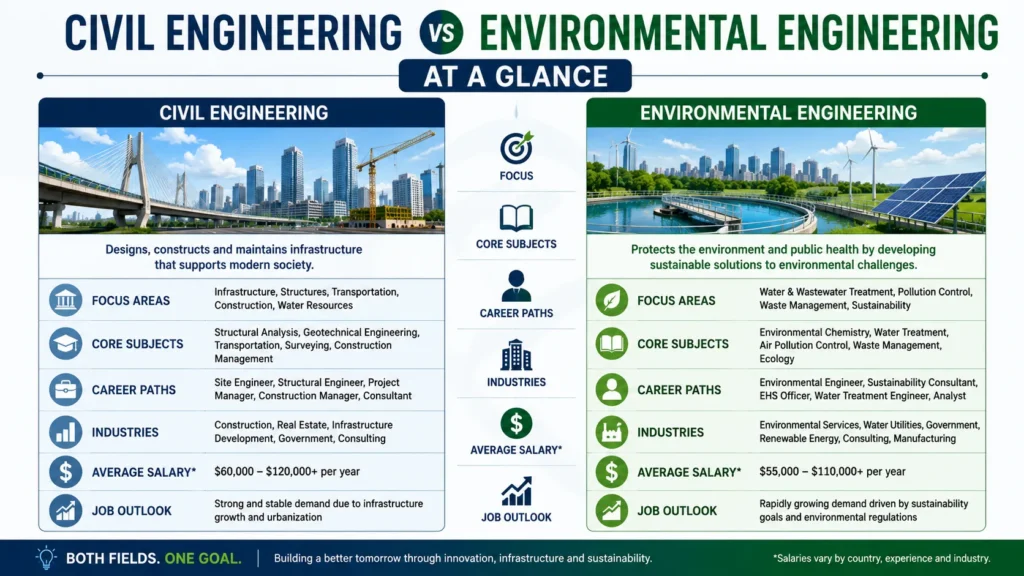
Which Engineering Field Is Better for Entrepreneurship?
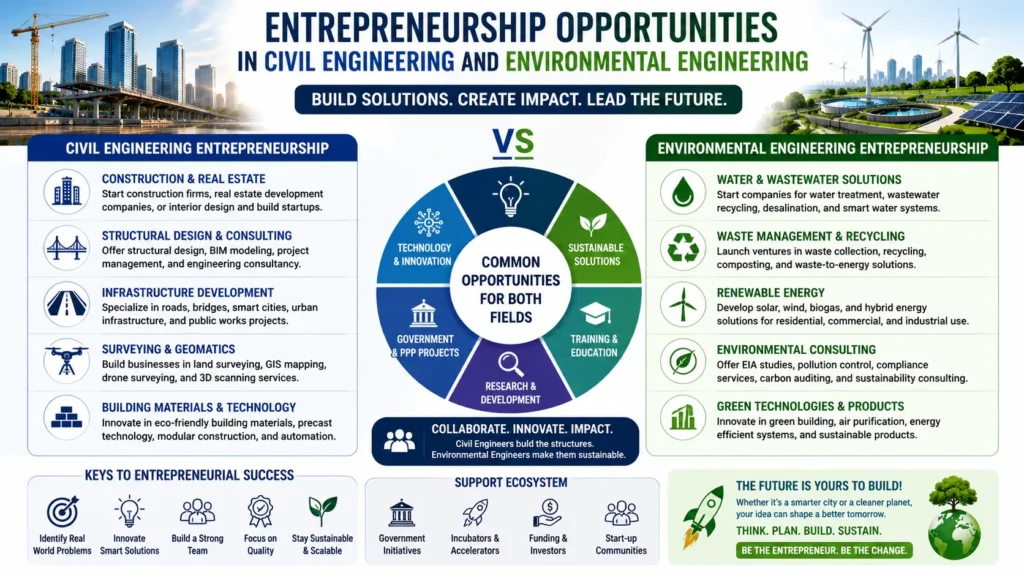
Both Civil Engineering and Environmental Engineering offer excellent opportunities for entrepreneurship, but Civil Engineering generally provides a broader range of business opportunities. The construction and infrastructure sectors create consistent demand for engineering services, making it easier for Civil Engineers to start consulting firms, construction companies, design practices, or project management businesses. Environmental Engineering, while more specialized, is experiencing rapid growth due to increasing environmental regulations, corporate sustainability goals, and the global transition toward clean technologies.
The best choice depends on your entrepreneurial interests. If you want to build a business around infrastructure, construction, or engineering consulting, Civil Engineering may offer greater flexibility. If you are passionate about sustainability, clean water, pollution control, or renewable energy, Environmental Engineering can provide access to fast-growing niche markets.
Entrepreneurship Comparison
| Factor | Civil Engineering | Environmental Engineering |
|---|---|---|
| Business Opportunities | Extensive | Specialized but growing rapidly |
| Startup Cost | Moderate to High | Low to Moderate (consulting) or High (technology solutions) |
| Market Demand | Consistently strong due to infrastructure development | Increasing due to environmental regulations and sustainability initiatives |
| Consulting Potential | Very High | Very High |
| Construction Business | Excellent | Limited |
| Environmental Consulting | Moderate | Excellent |
| Renewable Energy Opportunities | Moderate | High |
| Scalability | High | High |
| Government Contracts | Excellent | Excellent |
| Innovation Potential | High | Very High |
Entrepreneurial Opportunities in Civil Engineering
Civil Engineers can establish businesses in a variety of sectors, including:
- Civil engineering consulting
- Structural design services
- Construction companies
- Project management firms
- Infrastructure planning
- Quantity surveying
- Land development consulting
- Transportation engineering
- Surveying services
- Building inspection and quality assurance
- Construction technology solutions
- Building Information Modeling (BIM) services
These businesses benefit from continuous demand for residential, commercial, industrial, and public infrastructure projects.
Entrepreneurial Opportunities in Environmental Engineering
Environmental Engineers can build businesses focused on sustainability and environmental protection, such as:
- Environmental consulting
- Environmental Impact Assessment (EIA) services
- Water and wastewater treatment consulting
- Air pollution monitoring
- Waste management and recycling solutions
- Environmental compliance services
- Sustainability consulting
- Carbon footprint assessments
- Renewable energy consulting
- ESG (Environmental, Social, and Governance) advisory
- Climate risk and resilience consulting
- Green building certification support
As governments and organizations adopt stricter environmental standards, demand for these services continues to grow.
Which Field Has Greater Growth Potential?
Civil Engineering Entrepreneurship
Advantages:
- Large and established market.
- Continuous demand for infrastructure projects.
- Wide range of service offerings.
- Opportunities to expand into construction, real estate, and project management.
- Strong potential for government and private-sector contracts.
Challenges:
- Higher startup costs for construction-related businesses.
- Intense competition.
- Significant legal, financial, and operational responsibilities.
Environmental Engineering Entrepreneurship
Advantages:
- Growing demand driven by sustainability and environmental regulations.
- Opportunities in emerging sectors such as renewable energy and climate adaptation.
- Lower startup costs for consulting-based businesses.
- High potential for innovation and technology-driven solutions.
Challenges:
- More specialized market.
- Success often depends on regulatory changes and environmental policies.
- Some services require advanced technical expertise and certifications.
Key Skills for Engineering Entrepreneurs
Successful entrepreneurs in either field should develop skills beyond engineering, including:
- Business planning
- Financial management
- Marketing and branding
- Leadership
- Client relationship management
- Contract negotiation
- Project management
- Risk assessment
- Strategic decision-making
- Digital technology and AI adoption
Which Engineering Field Is Better for Starting a Business?
The answer depends on your goals:
- Choose Civil Engineering if you want to launch a construction company, engineering consultancy, infrastructure design firm, or project management business with access to a broad and established market.
- Choose Environmental Engineering if you want to build a business around sustainability, environmental consulting, renewable energy, water treatment, pollution control, or climate resilience.
Which Engineering Field Is Better for Women?
Neither Civil Engineering nor Environmental Engineering is inherently better for women. Both fields offer rewarding careers, competitive salaries, leadership opportunities, and the chance to work on projects that improve society. The better choice depends on your interests, strengths, and long-term career goals—not your gender.
Today, many women are thriving as Civil Engineers, Environmental Engineers, project managers, consultants, researchers, and business owners. Engineering employers increasingly promote diversity, equal opportunities, flexible work arrangements, and inclusive workplaces, making both disciplines more accessible than ever.
Civil Engineering vs Environmental Engineering for Women
| Factor | Civil Engineering | Environmental Engineering |
|---|---|---|
| Career Opportunities | Excellent | Excellent |
| Salary Potential | High | High |
| Leadership Roles | Strong opportunities in construction, consulting, and infrastructure | Strong opportunities in consulting, sustainability, utilities, and research |
| Work Environment | Office, construction sites, and field locations | Office, laboratories, fieldwork, treatment facilities, and consulting environments |
| Work-Life Balance | Varies by employer and project schedule | Often offers greater flexibility in consulting, government, and research roles |
| Entrepreneurship | Strong opportunities in construction and consulting | Strong opportunities in sustainability and environmental consulting |
| Demand | High due to ongoing infrastructure development | High due to environmental regulations and sustainability initiatives |
| Growth Potential | Excellent | Excellent |
Why Women Succeed in Both Fields
Success in engineering depends on professional skills and technical expertise rather than gender. Women in both disciplines often excel because they bring strengths such as:
- Analytical and critical thinking
- Problem-solving
- Communication and collaboration
- Leadership and project management
- Creativity and innovation
- Attention to detail
- Adaptability and resilience
These qualities are highly valued across engineering industries.
What Are the Advantages of Civil Engineering and Environmental Engineering?
Advantages of Civil Engineering
Civil Engineering offers several benefits for professionals interested in designing and developing the built environment.
1. Wide Career Opportunities
Civil Engineers can work in construction, transportation, infrastructure development, urban planning, consulting, water resources, and government agencies.
2. Diverse Specializations
The field includes numerous specializations, such as:
- Structural Engineering
- Transportation Engineering
- Geotechnical Engineering
- Construction Engineering
- Water Resources Engineering
- Coastal Engineering
- Municipal Engineering
This allows professionals to tailor their careers to their interests.
3. Strong Global Demand
Countries worldwide continue to invest in roads, bridges, railways, airports, smart cities, and public infrastructure, creating long-term employment opportunities.
4. Competitive Salary
Civil Engineers often earn attractive salaries, with additional opportunities for bonuses, promotions, and senior management positions.
5. Entrepreneurial Opportunities
Many Civil Engineers establish successful businesses in construction, consulting, structural design, surveying, or project management.
6. Visible Impact
Civil Engineers create infrastructure that communities rely on every day, leaving a lasting legacy through buildings, bridges, transportation systems, and public facilities.
Advantages of Environmental Engineering
Environmental Engineering is ideal for professionals who want to combine engineering with sustainability and environmental stewardship.
1. Meaningful Environmental Impact
Environmental Engineers help improve air quality, protect water resources, reduce pollution, and conserve natural ecosystems.
2. Rapidly Growing Industry
Increasing environmental regulations, climate change initiatives, and corporate sustainability goals continue to expand career opportunities.
3. Diverse Career Paths
Professionals can work in:
- Environmental consulting
- Water and wastewater treatment
- Renewable energy
- Waste management
- Environmental compliance
- Climate resilience
- Sustainability management
4. High Demand Across Multiple Sectors
Governments, utilities, manufacturers, energy companies, and consulting firms actively hire Environmental Engineers to improve environmental performance.
5. Innovation and Technology
Environmental Engineers frequently work with advanced technologies such as:
- Water treatment systems
- Air pollution control technologies
- Environmental monitoring systems
- Renewable energy solutions
- GIS and environmental modeling
- Smart environmental sensors
6. Contribution to Sustainable Development
Environmental Engineers play a vital role in helping organizations meet sustainability targets, reduce carbon emissions, and adapt to climate change.
Civil Engineering vs Environmental Engineering Salary by Country (2026)
Salaries for Civil Engineers and Environmental Engineers vary depending on the country, level of experience, industry, and local demand. Developed economies generally offer the highest compensation, while regions investing heavily in infrastructure and sustainability provide strong career opportunities. Countries such as Switzerland, the United States, Australia, the UAE, and Luxembourg remain among the highest-paying destinations for engineering professionals in 2026.
The table below compares estimated average salaries across major economies.
Civil Engineering vs Environmental Engineering Salary Comparison (2026)
| Country | Civil Engineer Salary | Environmental Engineer Salary | Key Insight |
|---|---|---|---|
| 🇺🇸 United States | $95,000–$105,000/year | $88,000–$95,000/year | Civil Engineers generally earn slightly more, while Environmental Engineers specializing in water and wastewater remain highly competitive. |
| 🇨🇭 Switzerland | Up to $135,000/year | Up to $135,000/year | One of the world’s highest-paying countries for both engineering disciplines. |
| 🇱🇺 Luxembourg | Up to $120,000/year | Up to $120,000/year | Strong salaries driven by advanced infrastructure and environmental initiatives. |
| 🇦🇪 United Arab Emirates | $73,000/year (AED 269,000) | Up to $95,000/year (AED 350,000) | Tax-free income and large infrastructure projects make the UAE attractive for international engineers. |
| 🇦🇺 Australia | $80,000–$89,000/year | $75,000–$85,000/year | High demand for infrastructure, transportation, and water resource specialists. |
| 🇵🇰 Pakistan | PKR 80,000–150,000/month | Approx. PKR 3.03 million/year | Salaries continue to grow with increasing investment in infrastructure and environmental management. |
| 🇸🇦 Saudi Arabia | SAR 7,000–12,000/month | SAR 8,500–15,000/month | Tax-free salaries and major development projects create strong opportunities for engineers. |
Key Salary Insights
💰 Highest-Paying Countries: Switzerland and Luxembourg offer the highest average salaries for both Civil and Environmental Engineers.
🌍 Best Tax-Free Earnings: The UAE and Saudi Arabia provide tax-free salaries, making them attractive destinations for expatriate engineers.
🌱 Growing Demand for Environmental Engineers: Environmental Engineers often earn competitive salaries in countries investing heavily in sustainability, clean energy, water management, and climate resilience.
🏗️ Civil Engineering Advantage: Civil Engineers generally earn slightly higher salaries due to the scale of infrastructure, transportation, and construction projects worldwide.
Which Engineering Field Pays More?
In most countries, Civil Engineers earn slightly higher average salaries, particularly in construction, structural engineering, and large-scale infrastructure development. However, Environmental Engineers can earn equal or even higher salaries when working in specialized fields such as water and wastewater treatment, renewable energy, environmental consulting, or climate resilience projects.
Frequently Asked Questions (FAQs)
Have questions about Civil Engineering vs Environmental Engineering? Explore answers to some of the most frequently asked questions about the differences between these engineering disciplines, curriculum, career opportunities, salaries, job outlook, required skills, specializations, industry applications, and how to choose the right engineering career for your future.