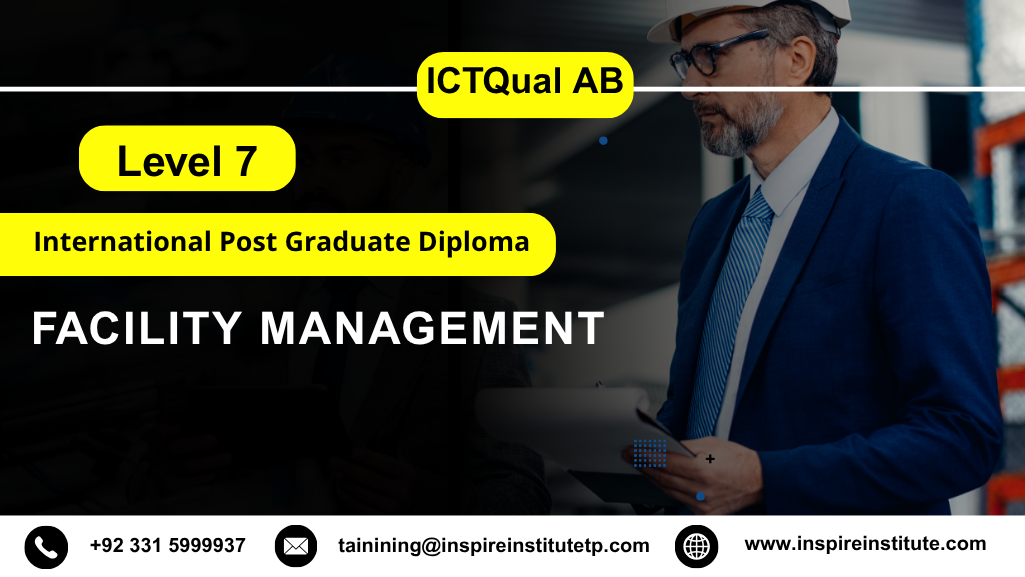
ICTQual AB Level 7 International Post Graduate Diploma in Facility Management

ICTQual AB Level 7 International Post Graduate Diploma in Facility Management

The ICTQual AB Level 7 International Post Graduate Diploma in Facility Management is an advanced professional qualification designed for individuals seeking expertise in modern facility management, strategic planning, and organisational operations. It focuses on the effective management of buildings, workplaces, infrastructure, and support services to improve operational efficiency, workplace safety, and long-term sustainability. This qualification supports professionals in developing the knowledge required to manage complex facilities across commercial, industrial, healthcare, educational, and corporate environments.

The ICTQual AB Level 7 International Post Graduate Diploma in Facility Management emphasises strategic facility planning, maintenance management, asset optimisation, health and safety compliance, risk assessment, energy efficiency, and sustainable building operations. Learners develop an understanding of how facility managers coordinate resources, control operational costs, manage service providers, and maintain functional, safe, and productive working environments. These competencies are relevant to organisations seeking reliable facility management systems aligned with operational objectives and international professional practices.

This postgraduate diploma is suitable for experienced professionals, supervisors, managers, and individuals working in facilities, property, maintenance, engineering, and building operations. It strengthens leadership, decision-making, problem-solving, and resource management capabilities for demanding facility management responsibilities. With its focus on strategic performance, sustainability, and operational excellence, the ICTQual AB Level 7 International Post Graduate Diploma in Facility Management provides valuable professional development for individuals aiming to enhance their expertise and contribute to efficient facility operations across diverse industries and international workplaces.

Overview

Certifying Body

ICTQual AB

Course Duration

120 Credits

Evaluation

Assignment Based

Study Units

6

Learning Mode

Online

Qualification Structure

The ICTQual AB Level 7 International Post Graduate Diploma in Facility Management, qualification consisting of 6 mandatory study units.

Mandatory Units

  1. Strategic Leadership and Governance in Facility Management
  2. Advanced Facilities Asset and Infrastructure Management
  3. Strategic Risk, Health, Safety and Compliance Management
  4. Financial Planning, Procurement and Contract Management in Facilities
  5. Sustainability, Smart Buildings and Digital Transformation in Facility Management
  6. Strategic Facility Management Project and Research Methods

Here are the learning outcomes for each study unit:

Unit 1: Strategic Leadership and Governance in Facility Management

By the end of this unit, Learners will be able to:

  1. Critically evaluate strategic leadership principles and governance frameworks applicable to complex facility management environments.
  2. Analyse how facility management strategies align with organisational vision, corporate objectives, stakeholder expectations, and long-term business performance.
  3. Evaluate leadership approaches for managing multidisciplinary teams, organisational change, stakeholder relationships, and strategic decision-making.
  4. Develop governance policies and strategic management frameworks that promote accountability, transparency, ethical practice, and operational effectiveness.
  5. Formulate strategic recommendations to improve organisational performance, strengthen management systems, and support continuous improvement in facility management.

Unit 2: Advanced Facilities Asset and Infrastructure Management

By the end of this unit, Learners will be able to:

  1. Critically analyse advanced asset management principles and infrastructure strategies for maintaining reliability, functionality, and long-term asset value.
  2. Evaluate asset lifecycle management approaches, including condition assessment, maintenance optimisation, refurbishment planning, and replacement decisions.
  3. Develop strategic maintenance and infrastructure management plans that balance operational requirements, asset performance, risk, and lifecycle costs.
  4. Assess the application of asset performance data, predictive maintenance technologies, and condition monitoring systems to improve infrastructure reliability.
  5. Formulate recommendations for optimising asset utilisation, infrastructure resilience, maintenance expenditure, and long-term organisational performance.

Unit 3: Strategic Risk, Health, Safety and Compliance Management

By the end of this unit, Learners will be able to:

  1. Critically evaluate strategic risk management frameworks and their application to complex facility operations and infrastructure environments.
  2. Develop integrated risk assessment and mitigation strategies addressing occupational health and safety, fire safety, environmental hazards, security, and operational continuity.
  3. Analyse applicable legal, regulatory, and organisational compliance requirements relevant to facility management and building operations.
  4. Evaluate emergency preparedness, incident management, business continuity, and crisis response arrangements to strengthen organisational resilience.
  5. Design strategic monitoring and review mechanisms to improve compliance assurance, safety performance, risk governance, and organisational accountability.

Unit 4: Financial Planning, Procurement and Contract Management in Facilities

By the end of this unit, Learners will be able to:

  1. Critically analyse financial planning, budgeting, expenditure control, and cost optimisation strategies for complex facility management operations.
  2. Develop financial management approaches that evaluate capital investment, operational expenditure, asset lifecycle costs, and long-term value.
  3. Evaluate procurement strategies, supplier selection processes, and sourcing models to support organisational objectives and service delivery requirements.
  4. Design contract management and supplier performance frameworks incorporating service-level agreements, performance indicators, risk allocation, and contractual compliance.
  5. Formulate recommendations for improving financial accountability, procurement efficiency, supplier relationships, and value for money across facility management services.

Unit 5: Sustainability, Smart Buildings and Digital Transformation in Facility Management

By the end of this unit, Learners will be able to:

  1. Critically evaluate sustainability frameworks and environmental management strategies for improving the long-term performance of buildings and facilities.
  2. Analyse smart building technologies, building management systems, Internet of Things applications, and automation solutions within modern facility management.
  3. Develop strategies for energy optimisation, resource efficiency, waste reduction, and environmental performance improvement across facility operations.
  4. Evaluate the use of digital technologies, data analytics, and computerised maintenance management systems to support evidence-based decision-making.
  5. Formulate digital transformation and sustainability initiatives that improve operational efficiency, building resilience, environmental responsibility, and organisational competitiveness.

Unit 6: Strategic Facility Management Project and Research Methods

By the end of this unit, Learners will be able to:

  1. Develop strategic facility management project plans incorporating objectives, scope, deliverables, budgets, resources, timelines, and stakeholder requirements.
  2. Critically evaluate project management methodologies, risk management techniques, and change management strategies for complex facility improvement projects.
  3. Design appropriate research approaches to investigate facility management challenges, evaluate operational performance, and support evidence-based decision-making.
  4. Analyse qualitative and quantitative data using suitable research methods to assess facility performance, identify improvement opportunities, and inform strategic recommendations.
  5. Produce evidence-based project reports and strategic recommendations that support innovation, continuous improvement, and long-term organisational effectiveness in facility management.
Entry Requirements

Entry Requirements

  • Applicants must be at least 21 years old at the time of enrolment
  • A relevant bachelor’s degree or an equivalent recognised qualification is recommended.
  • Relevant professional experience in facility management, property management, engineering, maintenance, or building operations is beneficial.
  • Applicants should have a good command of English to understand course materials and complete assessments effectively.

What You Need to Know

This qualification is suitable for facility managers, property managers, maintenance professionals, engineers, supervisors, and individuals seeking to strengthen their expertise in facility management.

Learners can develop strategic planning, leadership, resource allocation, risk assessment, maintenance coordination, problem-solving, and operational decision-making skills relevant to facility management.

Relevant career pathways may include Facility Manager, Facilities Operations Manager, Property Manager, Maintenance Manager, Asset Manager, and Facilities Consultant, depending on experience and employer requirements.

Facility management professionals are employed across healthcare, education, hospitality, commercial real estate, manufacturing, construction, corporate offices, and public-sector organisations.

International recognition depends on the awarding body’s status, the qualification’s applicable recognition arrangements, and the requirements of employers or relevant authorities in each country. Applicants should verify these details with ICTQual AB and their chosen training provider.

Apply for This Course

Similar Posts