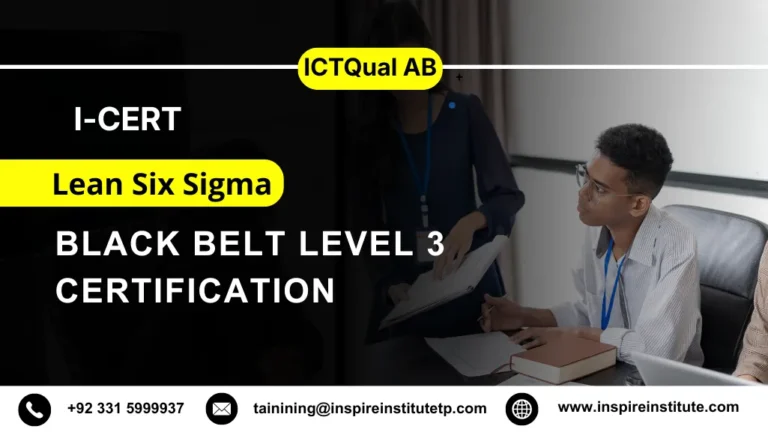
I-CERT Lean Six Sigma Black Belt Certification

Overview

Certifying Body

Ictqual ab

Course Duration

4 to 6 months

Evaluation

Assessment Based

Study Units

12

Learning Mode

Online

Qualification Structure

To achieve the I-CERT Lean Six Sigma Black Belt Certification; Candidates must complete the 12 Mandatory units,

Mandatory Units

  1. Introduction to Lean Six Sigma & Black Belt Role
  2. Define Phase – Project Selection & Chartering
  3. Measure Phase – Data Collection & Performance Metrics
  4. Measure Phase – Statistical Foundations
  5. Analyze Phase – Root Cause & Data Analysis
  6. Improve Phase – Solution Development & Validation
  7. Control Phase – Sustaining Improvements
  8. Advanced Lean Tools & Techniques
  9. Leadership & Change Management
  10. Financial Analysis & Project Benefits Realisation
  11. Risk Management & Compliance in Process Improvement
  12. Black Belt Capstone Project

Upon the successfully Completion I-CERT Lean Six Sigma Black Belt Certification; learners will be able to

Introduction to Lean Six Sigma & Black Belt Role

  • Understand Lean Six Sigma principles and methodology at an advanced level.
  • Comprehend the strategic responsibilities and role of a Black Belt.
  • Recognize the organizational impact of process improvement initiatives.
  • Identify opportunities to apply Lean Six Sigma within manufacturing and service environments.

Define Phase – Project Selection & Chartering

  • Select high-impact projects aligned with business objectives.
  • Develop detailed project charters defining scope, objectives, and success metrics.
  • Prioritize initiatives based on organizational strategy and operational value.
  • Establish measurable goals and timelines for process improvement projects.

Measure Phase – Data Collection & Performance Metrics

  • Collect accurate and reliable process data for analysis.
  • Map processes to identify inefficiencies and key performance indicators (KPIs).
  • Establish baseline performance metrics to track improvement.
  • Analyze process inputs and outputs to ensure comprehensive measurement.

Measure Phase – Statistical Foundations

  • Apply statistical techniques to evaluate process variation.
  • Conduct measurement system analysis to ensure data reliability.
  • Interpret data to support fact-based decision-making.
  • Utilize charts, graphs, and statistical tools to visualize performance trends.

Analyze Phase – Root Cause & Data Analysis

  • Identify root causes of defects, inefficiencies, and process bottlenecks.
  • Use advanced data analysis techniques to validate hypotheses.
  • Translate analytical findings into actionable improvement strategies.
  • Perform risk and impact analysis to prioritize corrective actions.

Improve Phase – Solution Development & Validation

  • Develop, test, and implement effective process improvement solutions.
  • Optimize workflows and eliminate operational waste.
  • Validate solutions using data-driven methods to ensure impact.
  • Engage cross-functional teams to implement improvements successfully.

Control Phase – Sustaining Improvements

  • Develop control plans to maintain process improvements.
  • Monitor KPIs to ensure long-term stability and performance.
  • Implement corrective measures for deviations.
  • Foster a culture of continuous improvement and sustainability.

Advanced Lean Tools & Techniques

  • Apply advanced Lean tools such as 5S, Kaizen, and Value Stream Mapping.
  • Integrate Lean tools with Six Sigma methodologies for maximum impact.
  • Enhance operational efficiency, productivity, and product quality.
  • Reduce waste and standardize processes across manufacturing and service operations.

Leadership & Change Management

  • Lead cross-functional teams to implement improvement initiatives.
  • Drive cultural change and promote a continuous improvement mindset.
  • Develop stakeholder engagement and communication strategies.
  • Manage resistance to change and ensure adoption of Lean Six Sigma practices.

Financial Analysis & Project Benefits Realization

  • Evaluate financial impact and ROI of process improvement initiatives.
  • Quantify cost savings, efficiency gains, and operational benefits.
  • Communicate business value to leadership and stakeholders.
  • Align project outcomes with strategic organizational goals.

Risk Management & Compliance in Process Improvement

  • Identify risks and develop mitigation strategies within processes.
  • Ensure compliance with ISO and industry standards.
  • Integrate risk management practices into Lean Six Sigma initiatives.
  • Monitor and sustain compliance while implementing continuous improvements.

Black Belt Capstone Project

  • Execute a real-world project demonstrating mastery of Lean Six Sigma tools.
  • Apply DMAIC methodology to deliver measurable operational improvements.
  • Present results, insights, and recommendations to leadership.
  • Showcase practical expertise in leading strategic process improvement initiatives.
Entry Requirements

Entry Requirements

  • Applicants must be at least 18 years old at the time of enrolment
  • A high school diploma, equivalent qualification, or higher education is recommended.
  • Prior experience in quality management, operations, manufacturing, engineering, business improvement, or a related field is beneficial but not mandatory.
  • Since the programme is delivered in English, applicants must demonstrate sufficient proficiency in the language.

What You Need to Know

This course is ideal for quality professionals, managers, engineers, project leaders, and consultants. It also suits individuals seeking advanced operational excellence skills.

Learner will learn advanced DMAIC methodologies, statistical analysis, process optimization, and continuous improvement techniques.

Yes, it develops leadership, team management, communication, and decision-making skills.

It strengthens your professional profile and prepares you for leadership positions. Many employers value certified professionals for quality improvement roles.

Yes, project managers benefit from structured improvement methodologies and analytical tools.

It helps organizations improve efficiency, reduce waste, and optimize business performance.

Apply for This Course

Similar Posts