Overview

Certifying Body

LICQual

Total Credits

120

Evaluation

Assignments Based

Qualification Type

Non Ofqual

Learning Mood

Online

Study Units

6

Qualification #

LICQ2201252

Qualification Structure

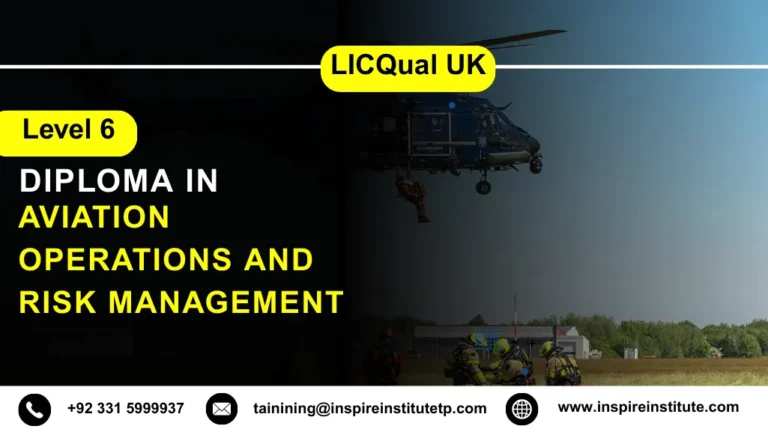
To achieve the LICQual UK Level 6 Diploma in Airline Safety;

Candidates must complete the following 6 Mandatory Units,

Mandatory Units

  • Strategic Airline Safety Management and Operational Planning
  • International Aviation Law, Global Policy, and Regulatory Compliance
  • Advanced Airline Safety Systems and Risk Management
  • Aviation Finance, Safety Investment Strategies, and Resource Optimization
  • Leadership, Human Resource Development, and Safety Culture in Airline Operations
  • Innovation, Emerging Technologies, and Sustainable Practices in Airline Safety Management

Upon the successfully LICQual UK Level 6 Diploma in Airline Safety, learners will be able to

  • Strategic Airline Safety Management and Operational Planning

By the end of this unit, learners will be able to:

  • Apply advanced principles of airline safety management to strategic and operational planning.
  • Evaluate airline scheduling, route planning, and operational efficiency with a focus on safety outcomes.
  • Integrate safety performance indicators into organizational decision-making and resource allocation.
  • Develop comprehensive safety management frameworks aligned with ICAO and international standards.
  • Critically assess operational risks and propose mitigation strategies for complex airline environments.
  • Design strategic safety plans that balance regulatory compliance, cost efficiency, and passenger safety.
  • International Aviation Law, Global Policy, and Regulatory Compliance

By the end of this unit, learners will be able to:

  • Interpret and apply international aviation law, treaties, and conventions to airline operations.
  • Analyze global aviation policies and their impact on airline safety and compliance frameworks.
  • Evaluate regulatory requirements from ICAO, EASA, FAA, and other authorities in a global context.
  • Assess the implications of bilateral and multilateral agreements on airline safety and operations.
  • Formulate compliance strategies that align with international aviation law and corporate governance.
  • Demonstrate awareness of ethical, cultural, and sustainability considerations in global aviation policy.
  • Advanced Airline Safety Systems and Risk Management

By the end of this unit, learners will be able to:

  • Implement advanced safety management systems (SMS) within airline operations.
  • Conduct comprehensive risk assessments using quantitative and qualitative methodologies.
  • Analyze safety data to identify trends, hazards, and systemic vulnerabilities.
  • Apply predictive risk management tools to prevent incidents and enhance operational resilience.
  • Integrate safety systems with quality, security, and compliance frameworks for holistic management.
  • Evaluate the effectiveness of safety audits, investigations, and continuous improvement processes.
  • Aviation Finance, Safety Investment Strategies, and Resource Optimization

By the end of this unit, learners will be able to:

  • Analyze aviation finance principles and their role in sustaining airline safety initiatives.
  • Evaluate cost–benefit models for safety investments and resource allocation.
  • Develop financial strategies that balance profitability with safety and compliance obligations.
  • Assess the impact of global economic trends on aviation safety funding and risk management.
  • Formulate investment strategies for safety technologies, training, and infrastructure.
  • Optimize resource utilization to achieve sustainable safety performance in airline operations.
  • Leadership, Human Resource Development, and Safety Culture in Airline Operations

By the end of this unit, learners will be able to:

  • Demonstrate leadership strategies that foster a strong airline safety culture.
  • Evaluate the role of human factors and crew resource management in aviation safety.
  • Design HR development programs that enhance safety awareness and professional competence.
  • Apply organizational psychology principles to improve safety communication and decision-making.
  • Assess the impact of leadership styles on safety performance and employee engagement.
  • Promote continuous improvement and accountability within airline safety teams.

Innovation, Emerging Technologies, and Sustainable Practices in Airline Safety Management

By the end of this unit, learners will be able to:

  • Evaluate the role of emerging technologies such as AI, big data, and automation in airline safety.
  • Assess the impact of digital transformation on safety monitoring, reporting, and compliance.
  • Integrate sustainable practices into safety management systems to meet global environmental goals.
  • Analyze case studies of innovative safety solutions in aviation and their measurable outcomes.
  • Formulate strategies for adopting new technologies while managing associated risks.
  • Demonstrate critical awareness of future trends shaping global airline safety management.
Entry Requirements

Entry Requirements

  • Learners must be at least 21 years old at the time of enrolment.
  • A recognised Level 5 Diploma or equivalent qualification in aviation, business, or a related field.
  • A minimum of 2–3 years of professional experience in airline operations, aviation safety, security, or related roles is recommended
  • Learners should demonstrate the ability to:
  • Read and interpret academic and technical texts.
  • Write structured reports and assignments.
  • Communicate effectively in discussions and presentations.
What You Need to Know

This diploma is designed for aviation professionals, graduates, and individuals aiming to move into supervisory, managerial, or leadership roles in airline safety and operations.

It equips you with advanced expertise in airline safety management, risk assessment, emergency response, and regulatory compliance, preparing you to handle complex safety challenges in global airline environments.

  • UK‑accredited and internationally recognised qualification
  • Builds advanced skills in safety, crisis management, and compliance
  • Enhances employability in senior aviation roles worldwide
  • Provides a pathway to postgraduate studies and specialised aviation programs

Graduates can pursue senior roles such as Airline Safety Manager, Flight Safety Officer, Operations Manager, Aviation Compliance Manager, Head of Airline Security, and Risk Management Specialist.

Learners can progress to Level 7 diplomas, executive aviation certifications, or postgraduate studies in aviation management, safety leadership, or business administration.

Yes. The LICQual UK Level 6 Diploma in Airline Safety is a UK-accredited qualification recognised internationally, supporting global employment and further study opportunities within airlines and aviation organisations worldwide.

Apply for This Course


Similar Posts