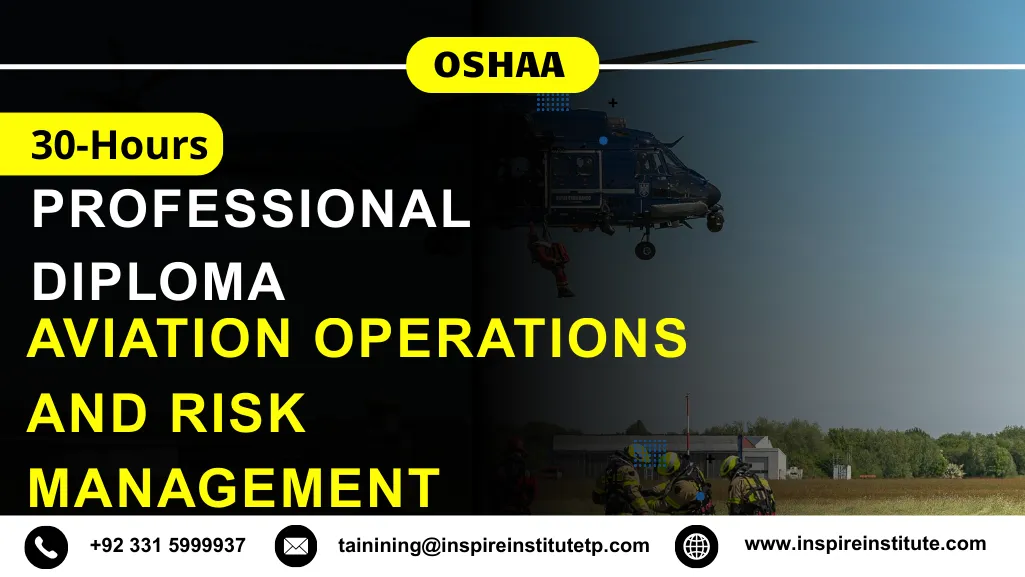
OSHAA 30-Hours Professional Diploma in Aviation Operations and Risk Management

Overview

Certifying Body

OSHAA

Total Credits

30 HOURS

Evaluation

Assignments Based

Course Category

Management

Learning Mood

Online

Qualification Structure

The study units below explain what learners will study and the learning outcomes they are expected to achieve.

  • Understand the structure and global significance of aviation operations in international trade and connectivity.
  • Identify the key stakeholders in aviation, including airlines, airports, regulators, and ground service providers.
  • Demonstrate knowledge of global safety standards and their role in ensuring operational excellence.
  • Recognize the importance of compliance and safety leadership in aviation operations.
  • Gain a comprehensive understanding of OSHA standards and their application in aviation environments.
  • Interpret international aviation regulations, including ICAO and IATA requirements.
  • Apply occupational health and safety principles to aviation-specific operations.
  • Develop awareness of employer responsibilities, employee rights, and enforcement mechanisms.
  • Learn the fundamentals of aviation risk management and its role in operational safety.
  • Apply risk management frameworks to identify, assess, and mitigate aviation hazards.
  • Understand the integration of risk management into daily aviation operations.
  • Develop strategies to enhance organizational resilience through proactive risk control.
  • Master essential procedures for safe and efficient airline and airport operations.
  • Apply safety protocols to minimize risks during ground handling and passenger services.
  • Understand the coordination required between airlines, airports, and regulatory authorities.
  • Implement best practices for operational safety and compliance in aviation facilities.
  • Conduct systematic hazard identification in aviation and transport operations.
  • Apply risk assessment methodologies to evaluate workplace threats.
  • Develop control measures to mitigate risks and enhance operational safety.
  • Integrate hazard prevention strategies into daily aviation workflows.
  • Understand the structure and function of Safety Management Systems (SMS) in aviation.
  • Apply proactive safety management practices to reduce risks and incidents.
  • Promote a positive workplace safety culture within aviation organizations.
  • Integrate SMS into organizational operations for long-term compliance and safety.
  • Understand the fundamentals of emergency response planning in aviation.
  • Develop crisis management strategies for accidents, security threats, and natural disasters.
  • Apply communication protocols during emergencies to ensure coordinated responses.
  • Evaluate case studies of past incidents to strengthen preparedness and resilience.
  • Interpret international aviation compliance frameworks and oversight mechanisms.
  • Apply compliance strategies to ensure adherence to safety and operational requirements.
  • Understand the role of audits, inspections, and certifications in maintaining compliance.
  • Develop strategies for continuous improvement in regulatory adherence.
  • Recognize the role of human factors in aviation safety and operational performance.
  • Understand the impact of fatigue, stress, and communication on safety outcomes.
  • Apply leadership strategies to encourage employee engagement in safety initiatives.
  • Strengthen communication skills to improve safety culture and team performance.
  • Demonstrate mastery of knowledge gained throughout the OSHAA 30-Hours Professional Diploma in Aviation Operations and Risk Management.
  • Apply theoretical knowledge to real-world case studies and operational scenarios.
  • Develop problem-solving skills for complex safety, compliance, and risk management challenges.
  • Showcase professional readiness to lead in aviation operations and regulatory compliance.
Entry Requirements

Entry Requirements

  • Applicants must be at least 18 years old at the time of enrollment.
  • A minimum of a high school diploma (or equivalent qualification) is required. Candidates with prior studies in engineering, aviation, or technical fields will have an advantage.
  • While beginners are welcome, 1–2 years of experience in aviation operations, engineering, or related industries is preferred.
  • Since the course is delivered in English, applicants must demonstrate basic to intermediate English proficiency.

What You Need to Know

This course is ideal for aviation professionals, engineers, safety officers, and students seeking to build expertise in aviation operations, risk management, and compliance standards.

The OSHAA 30-Hour Diploma provides essential training in aviation safety, operational efficiency, and risk assessment, helping you gain a competitive edge in the global aviation industry.

  • Comprehensive knowledge of aviation operations and safety protocols
  • Enhanced risk management and compliance skills
  • Globally recognized certification for career advancement
  • Practical, real-world training with industry relevance
  • Pathway to advanced aviation qualifications and higher education

Graduates can pursue roles such as aviation safety officer, operations manager, risk analyst, compliance specialist, or engineering support staff in airlines, airports, and aviation organizations.

This diploma serves as a foundation for advanced aviation certifications, specialized safety training, or higher education in aviation management and engineering disciplines.

Yes, the OSHAA 30-Hour Diploma is internationally recognized, making it valuable for professionals seeking global career opportunities in aviation operations and risk management.

Apply for This Course


Similar Posts